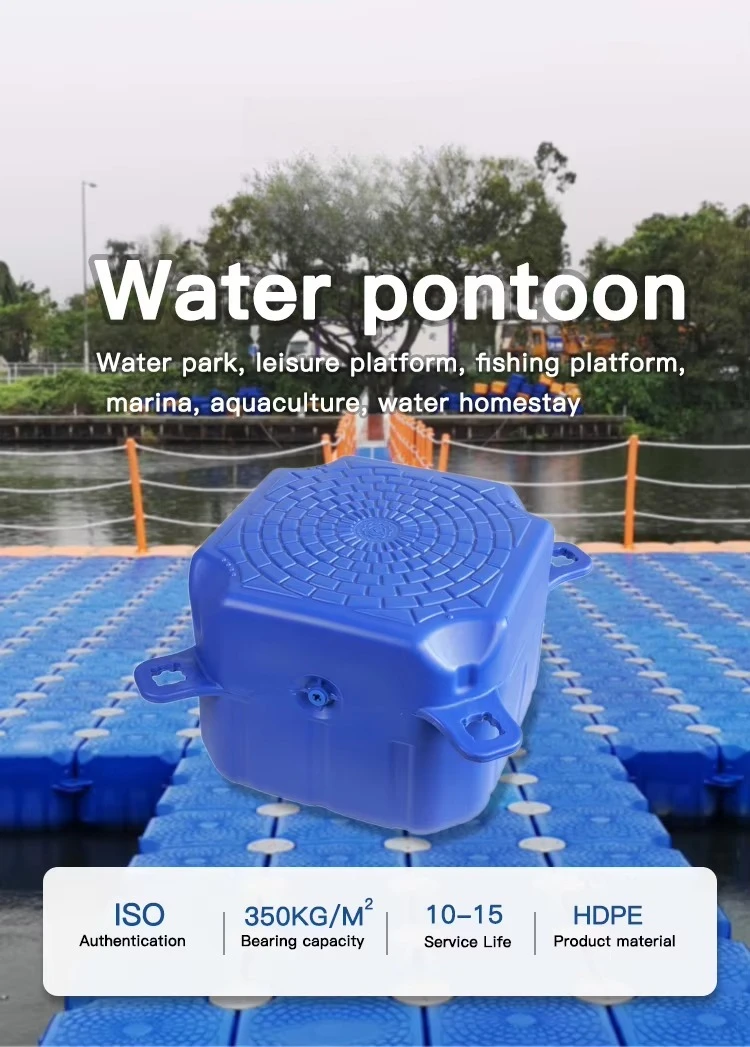
 [phitan Eggs](https://www.sciencedirect.com/science/article/abs/pii/S0963996925007409)
 pulau bakung, Lingga topografi landai (gentle slope/flat terrain) ditandai denggan kkemiringan lereng yangg sangat renedah antara 0-5%,
dimana peruahan keingin tanah sanggat minim.
straight of malaca average 25m depth. deeper at the begining and at the end.
lingga (depth 5m-52m with salinity 27-30.5ppt?)
# [Space Vector Pulse Width Modulation (SVPWM)](https://www.switchcraft.org/learning/2017/3/15/space-vector-pwm-intro)- Field Oriented Controller Motor
One common, modern method for controlling three-phase induction motors and permanent magnet synchronous motors (aka BLAC or PMAC motors) is field oriented control,
which independently controls the magnetizing and torque-producing components of the stator current. This allows the torque-producing component to be kept orthogonal
to the rotor flux, maximizing torque production.
Space vector pulse width modulation (SVPWM) is a technique used in the final step of field oriented control (FOC)
to determine the pulse-width modulated signals for the inverter switches in order to generate the desired 3-phase voltages to the motor.
pulau bakung, Lingga topografi landai (gentle slope/flat terrain) ditandai denggan kkemiringan lereng yangg sangat renedah antara 0-5%,
dimana peruahan keingin tanah sanggat minim.
straight of malaca average 25m depth. deeper at the begining and at the end.
lingga (depth 5m-52m with salinity 27-30.5ppt?)
# [Space Vector Pulse Width Modulation (SVPWM)](https://www.switchcraft.org/learning/2017/3/15/space-vector-pwm-intro)- Field Oriented Controller Motor
One common, modern method for controlling three-phase induction motors and permanent magnet synchronous motors (aka BLAC or PMAC motors) is field oriented control,
which independently controls the magnetizing and torque-producing components of the stator current. This allows the torque-producing component to be kept orthogonal
to the rotor flux, maximizing torque production.
Space vector pulse width modulation (SVPWM) is a technique used in the final step of field oriented control (FOC)
to determine the pulse-width modulated signals for the inverter switches in order to generate the desired 3-phase voltages to the motor.
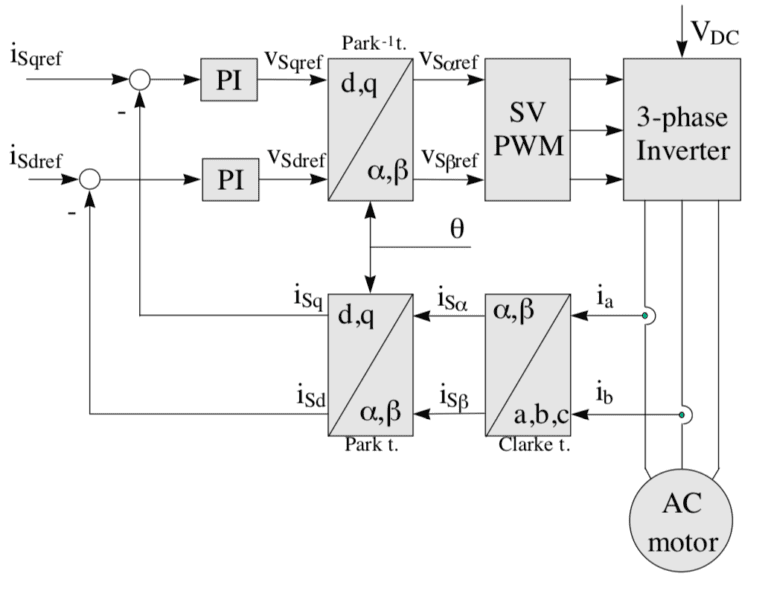 [clark park function](https://www.ti.com/lit/an/bpra048/bpra048.pdf)
[FPGA based Field Oriented Control (FOC) for driving Permanent Magnet Synchronous Motors (PMSM) or Brushless DC Motors (BLDC)](https://github.com/WangXuan95/FPGA-FOC)
[Technitium DNS Server self hosting open source embedded pi Hole]
- [docker compose](https://github.com/TechnitiumSoftware/DnsServer/blob/master/docker-compose.yml)
https://sg.indeed.com/viewjob?jk=01a9b79366c6d05d&tk=1jig4uc0rjudb801&from=jobi2a_jobmatch-reactivation-en-SG_email&rjptk=1jig4ub5g2qdq000&xpse=SoBr67I3mRkpXWTI8B0LbzkdCdPP&xfps=f0759927-33e4-4b50-a1fe-b1d9be1182f3&xkcb=SoCO67M3mQB2XagLyL0IbzkdCdPP
[libre workspace cloud](https://www.libre-workspace.org/en/libre-workspace-cloud/)
[clark park function](https://www.ti.com/lit/an/bpra048/bpra048.pdf)
[FPGA based Field Oriented Control (FOC) for driving Permanent Magnet Synchronous Motors (PMSM) or Brushless DC Motors (BLDC)](https://github.com/WangXuan95/FPGA-FOC)
[Technitium DNS Server self hosting open source embedded pi Hole]
- [docker compose](https://github.com/TechnitiumSoftware/DnsServer/blob/master/docker-compose.yml)
https://sg.indeed.com/viewjob?jk=01a9b79366c6d05d&tk=1jig4uc0rjudb801&from=jobi2a_jobmatch-reactivation-en-SG_email&rjptk=1jig4ub5g2qdq000&xpse=SoBr67I3mRkpXWTI8B0LbzkdCdPP&xfps=f0759927-33e4-4b50-a1fe-b1d9be1182f3&xkcb=SoCO67M3mQB2XagLyL0IbzkdCdPP
[libre workspace cloud](https://www.libre-workspace.org/en/libre-workspace-cloud/)
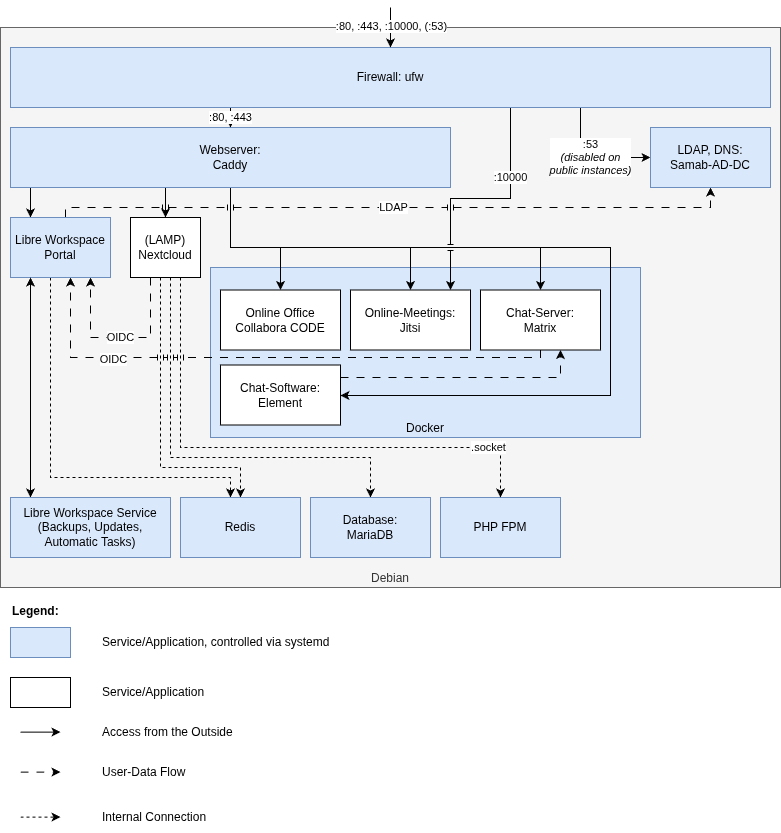 [libre workspace portal](https://docs.libre-workspace.org/modules/libre-workspace-portal.html)
```
uv add gunicorn
uv run gunicorn your_project.wsgi
uv run gunicorn --bind 0.0.0.0:8000 --workers 4 your_project.wsgi
gunicorn app.main:app \
-k uvicorn.workers.UvicornWorker \
-w 4 -b 0.0.0.0:8000
https://uvicorn.dev/
```
```
# https://github.com/astral-sh/setup-uv
uv add -r requirements/base.txt
uv add -r requirements/dev.txt --group dev
uv add -r requirements/deploy.txt --group deploy
git rm requirements/*.txt
This adds the base requirements to
```
[tailscale + Rustdesk = remote access vpn](https://langui.ch/2025/02/19/rustdesk-plus-tailscale/)
[pengajuan amdal untuk memelihara bebek](https://www.payungpaten.com/mengurus-perizinan-merek/)
[anchov as pellet feed](https://lautnusantara.com/detail/artikel/2206/utilization-of-anchovy-as-raw-material-for-fish-meal-in-livestock-feed)
[Induction motor vs Permanent Magnet motor](https://osenc.com/motor-and-permanent-magnet/)
# [Integrated Power Module (IPM)](https://americas.fujielectric.com/wp-content/uploads/2020/10/Small-IPM-MTET0-3288a_EN.pdf)
What is Dual MPPT Hybrid Inverter?
Dual MPPT Hybrid Inverter is a device that converts direct current (DC) from solar panels into alternating current (AC) for the grid or a battery.
It has two independent maximum power point trackers (MPPTs) that can optimize the power output of two different solar arrays. This allows for more
flexibility and efficiency in system design and performance. Using a 2 MPPT Hybrid Inverter is a great way to increase the power output of your solar panels.
What is the difference between single MPPT and dual MPPT ?
Single and dual MPPT are two types of Maximum Power Point Trackers (MPPTs) that are used in solar inverters to optimize the energy output of the solar panels.
MPPTs are electronic devices that adjust the voltage and current of the solar panels to match the maximum power point (MPP), which is the point where the panels generate the most power.
The main difference between single and dual MPPT is that single MPPT has only one input channel, while dual MPPT has two input channels.
This means that single MPPT can only connect to one string of solar panels, while dual MPPT can connect to two strings of solar panels.
A string is a series of solar panels that are wired together.
The advantage of dual MPPT is that it can handle different orientations, tilts, lengths, and types of solar panels more effectively than single MPPT.
This is because dual MPPT can track the MPP of each string independently, while single MPPT can only track the MPP of the whole array. Dual MPPT can also cope better
with shading issues, as it can isolate the shaded string from the unshaded one and prevent power loss.
The disadvantage of dual MPPT is that it is more expensive and complex than single MPPT. It also requires more wiring and installation time. Dual MPPT is typically
used for larger and more complicated solar systems, while single MPPT is more suitable for smaller and simpler solar systems.
[libre workspace portal](https://docs.libre-workspace.org/modules/libre-workspace-portal.html)
```
uv add gunicorn
uv run gunicorn your_project.wsgi
uv run gunicorn --bind 0.0.0.0:8000 --workers 4 your_project.wsgi
gunicorn app.main:app \
-k uvicorn.workers.UvicornWorker \
-w 4 -b 0.0.0.0:8000
https://uvicorn.dev/
```
```
# https://github.com/astral-sh/setup-uv
uv add -r requirements/base.txt
uv add -r requirements/dev.txt --group dev
uv add -r requirements/deploy.txt --group deploy
git rm requirements/*.txt
This adds the base requirements to
```
[tailscale + Rustdesk = remote access vpn](https://langui.ch/2025/02/19/rustdesk-plus-tailscale/)
[pengajuan amdal untuk memelihara bebek](https://www.payungpaten.com/mengurus-perizinan-merek/)
[anchov as pellet feed](https://lautnusantara.com/detail/artikel/2206/utilization-of-anchovy-as-raw-material-for-fish-meal-in-livestock-feed)
[Induction motor vs Permanent Magnet motor](https://osenc.com/motor-and-permanent-magnet/)
# [Integrated Power Module (IPM)](https://americas.fujielectric.com/wp-content/uploads/2020/10/Small-IPM-MTET0-3288a_EN.pdf)
What is Dual MPPT Hybrid Inverter?
Dual MPPT Hybrid Inverter is a device that converts direct current (DC) from solar panels into alternating current (AC) for the grid or a battery.
It has two independent maximum power point trackers (MPPTs) that can optimize the power output of two different solar arrays. This allows for more
flexibility and efficiency in system design and performance. Using a 2 MPPT Hybrid Inverter is a great way to increase the power output of your solar panels.
What is the difference between single MPPT and dual MPPT ?
Single and dual MPPT are two types of Maximum Power Point Trackers (MPPTs) that are used in solar inverters to optimize the energy output of the solar panels.
MPPTs are electronic devices that adjust the voltage and current of the solar panels to match the maximum power point (MPP), which is the point where the panels generate the most power.
The main difference between single and dual MPPT is that single MPPT has only one input channel, while dual MPPT has two input channels.
This means that single MPPT can only connect to one string of solar panels, while dual MPPT can connect to two strings of solar panels.
A string is a series of solar panels that are wired together.
The advantage of dual MPPT is that it can handle different orientations, tilts, lengths, and types of solar panels more effectively than single MPPT.
This is because dual MPPT can track the MPP of each string independently, while single MPPT can only track the MPP of the whole array. Dual MPPT can also cope better
with shading issues, as it can isolate the shaded string from the unshaded one and prevent power loss.
The disadvantage of dual MPPT is that it is more expensive and complex than single MPPT. It also requires more wiring and installation time. Dual MPPT is typically
used for larger and more complicated solar systems, while single MPPT is more suitable for smaller and simpler solar systems.
 [mppt 1](https://www.hinen.com/blogs/energy-storage/what-is-an-mppt-inverter)
 # [pi-Hole as DNS](https://pi-hole.net/)
[Alternative to pihole](https://amanvir.com/blog/turning-my-esp32-into-a-dns-sinkhole)
[reverse proxy](https://www.xda-developers.com/a-reverse-proxy-tied-my-entire-home-lab-together/)
[rexda](https://www.cnx-software.com/2023/10/04/inkplate-4-tempera-epaper-display-supports-esphome-arduino-and-micropython/)
Expansion- easyC (Qwicc/STEMMA Qt) connectors connected via PCAL6416 GPIO expander
[open os?](https://oniroproject.org/)
[OpenHarrmony](https://gitee.com/openharmony/kernel_liteos_m)
[gitee vs gihub](https://gitee.com/)
[paper ngx](https://www.ojambo.com/how-to-get-started-with-paperless-ngx-using-podman-a-beginner-friendly-guide)
[install paperngx ai](https://wz-it.com/en/blog/paperless-ai-installation-ubuntu-docker/)
```
git clone https://github.com/clusterzx/paperless-ai.git
cd paperless-ai
docker-compose up -d
```
[simple a-reverse-proxy-tied-my-entire-home-lab-together](https://jonathanklimt.de/programming/socat-proxy/)
https://github.com/jnqpblc/Randomness/blob/master/3.mapping/ipv6-socat-proxy-for-ipv4-tools.sh
#### sudo apt install socat curl -y
# ###/etc/systemd/system/puppet-proxy.service
# [Unit]
# Description=Puppet Proxy Application
#
# [Service]
# User=puppet
# ExecStart=/usr/bin/socat TCP6-LISTEN:8140,reuseaddr,fork TCP4:127.0.0.1:8140
#
# [Install]
# WantedBy=multi-user.target
# Hotel contact:
- Daik
-- Telp: +6281364537718 , +6282283931675
- Jadwal seitenam -Telaga punggur (Ocean 5) : hari selasa direct non -stop lebih lamabat yang stop
telaga punggur -seitenam: haris selasa stop ... berlainan karena satu naik dan satu turung
- Tanjung pinang - benan- Rejai- Sei Tenam - pulun -jagoh-daik
- MV Areena 2 : Tanjungpinang - Mensanak Pulau Duyung, Tajuh Biru, Senayang -Pancur
- Nawin HP: +628281364064034
cargo add adui-dioxus
KSL Hotel
33, Jalan Seladang,
Taman Abad, Johor Bahru,
Johor 8025
0, Malaysia
# [pi-Hole as DNS](https://pi-hole.net/)
[Alternative to pihole](https://amanvir.com/blog/turning-my-esp32-into-a-dns-sinkhole)
[reverse proxy](https://www.xda-developers.com/a-reverse-proxy-tied-my-entire-home-lab-together/)
[rexda](https://www.cnx-software.com/2023/10/04/inkplate-4-tempera-epaper-display-supports-esphome-arduino-and-micropython/)
Expansion- easyC (Qwicc/STEMMA Qt) connectors connected via PCAL6416 GPIO expander
[open os?](https://oniroproject.org/)
[OpenHarrmony](https://gitee.com/openharmony/kernel_liteos_m)
[gitee vs gihub](https://gitee.com/)
[paper ngx](https://www.ojambo.com/how-to-get-started-with-paperless-ngx-using-podman-a-beginner-friendly-guide)
[install paperngx ai](https://wz-it.com/en/blog/paperless-ai-installation-ubuntu-docker/)
```
git clone https://github.com/clusterzx/paperless-ai.git
cd paperless-ai
docker-compose up -d
```
[simple a-reverse-proxy-tied-my-entire-home-lab-together](https://jonathanklimt.de/programming/socat-proxy/)
https://github.com/jnqpblc/Randomness/blob/master/3.mapping/ipv6-socat-proxy-for-ipv4-tools.sh
#### sudo apt install socat curl -y
# ###/etc/systemd/system/puppet-proxy.service
# [Unit]
# Description=Puppet Proxy Application
#
# [Service]
# User=puppet
# ExecStart=/usr/bin/socat TCP6-LISTEN:8140,reuseaddr,fork TCP4:127.0.0.1:8140
#
# [Install]
# WantedBy=multi-user.target
# Hotel contact:
- Daik
-- Telp: +6281364537718 , +6282283931675
- Jadwal seitenam -Telaga punggur (Ocean 5) : hari selasa direct non -stop lebih lamabat yang stop
telaga punggur -seitenam: haris selasa stop ... berlainan karena satu naik dan satu turung
- Tanjung pinang - benan- Rejai- Sei Tenam - pulun -jagoh-daik
- MV Areena 2 : Tanjungpinang - Mensanak Pulau Duyung, Tajuh Biru, Senayang -Pancur
- Nawin HP: +628281364064034
cargo add adui-dioxus
KSL Hotel
33, Jalan Seladang,
Taman Abad, Johor Bahru,
Johor 8025
0, Malaysia
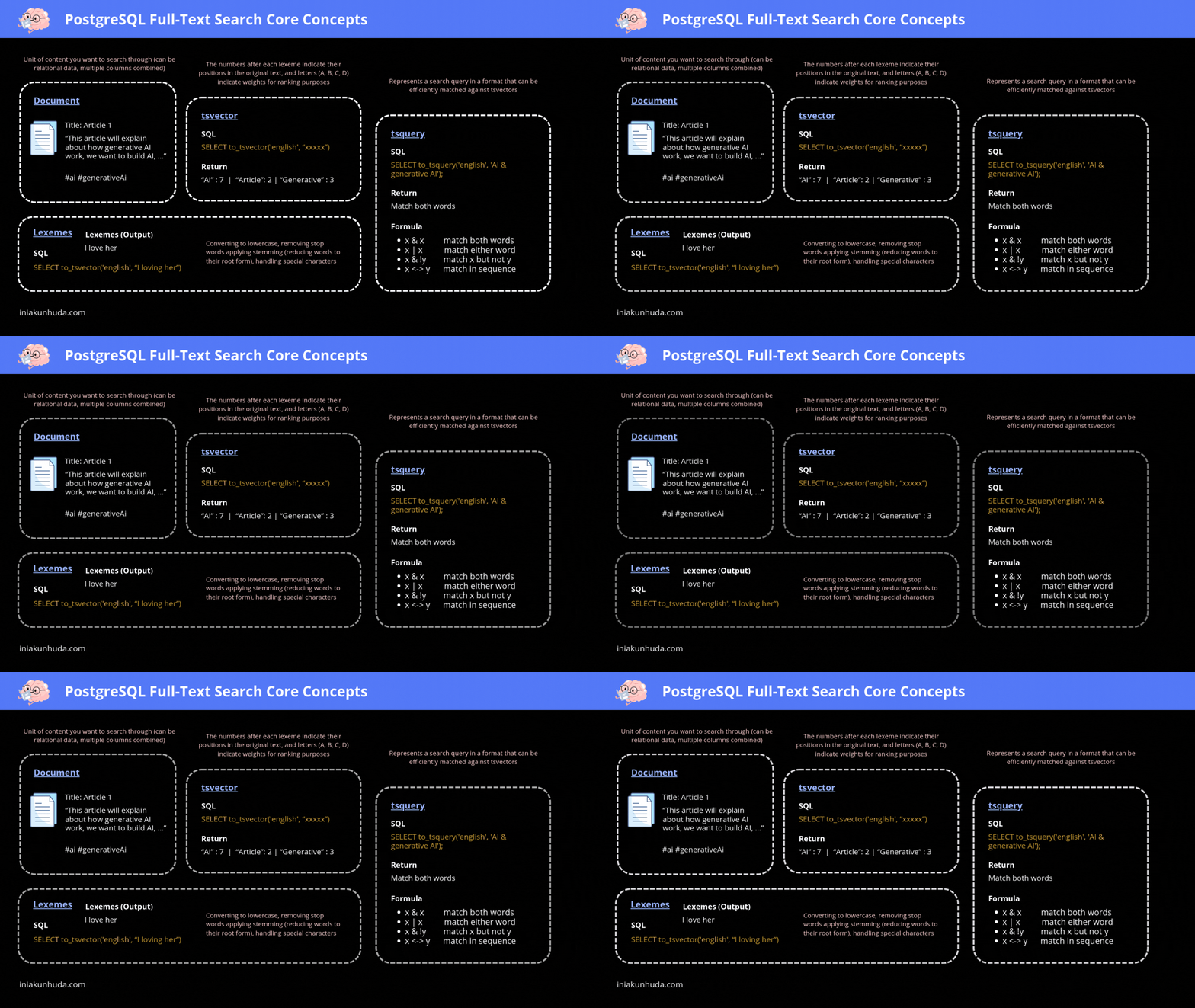 [vector_search](https://iniakunhuda.medium.com/postgresql-full-text-search-a-powerful-alternative-to-elasticsearch-for-small-to-medium-d9524e001fe0)
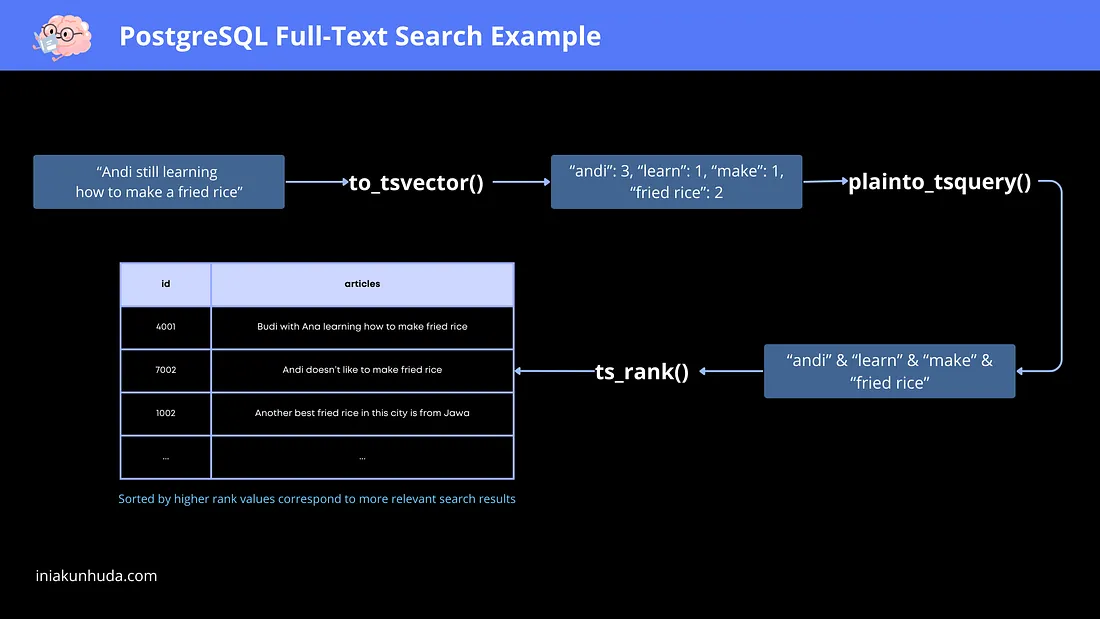 ```
-- Simple tsvector example
SELECT to_tsvector('english', 'The quick brown foxes are jumping over lazy dogs');
-- Output
-- 'brown':3 'dog':9 'fox':4 'jump':6 'lazi':8 'quick':2
-- Example with multiple occurrences and positions
SELECT to_tsvector('english', 'Running and running and running through the forest');
-- Output:
-- 'forest':7 'run':1,3,5
-- Combining fields with different weights
SELECT setweight(to_tsvector('english', title), 'A') ||
setweight(to_tsvector('english', content), 'B') AS weighted_document
FROM (
SELECT 'PostgreSQL Search Guide' as title,
'Learn how to search in PostgreSQL effectively' as content
) t;
-- Output:
-- 'guid':3A 'postgresql':1A 'search':2A 'effect':6B 'learn':4B 'postgresql':7B 'search':8B
```
# [UV on windows](https://flocode.substack.com/p/044-python-environments-again-uv)
- uv python install
- uv init
# [map in pdf](https://geops.com/en/blog/export-and-print-web-maps-as-pdf)
- JsPDF
- [react spatial gs](https://react-spatial.geops.io.)
- MapLibre
- openlayer
- https://www.npmjs.com/package/jspdf
const doc = new JsPDF({
orientation: "landscape",
unit: "pt",
format: "A4",
});
# htop ( monitor for linux)
[Natural Gas Engine](https://www.yanmar.com/global/engine/products/gas/v_watercooled/gas/)
```
-- Simple tsvector example
SELECT to_tsvector('english', 'The quick brown foxes are jumping over lazy dogs');
-- Output
-- 'brown':3 'dog':9 'fox':4 'jump':6 'lazi':8 'quick':2
-- Example with multiple occurrences and positions
SELECT to_tsvector('english', 'Running and running and running through the forest');
-- Output:
-- 'forest':7 'run':1,3,5
-- Combining fields with different weights
SELECT setweight(to_tsvector('english', title), 'A') ||
setweight(to_tsvector('english', content), 'B') AS weighted_document
FROM (
SELECT 'PostgreSQL Search Guide' as title,
'Learn how to search in PostgreSQL effectively' as content
) t;
-- Output:
-- 'guid':3A 'postgresql':1A 'search':2A 'effect':6B 'learn':4B 'postgresql':7B 'search':8B
```
# [UV on windows](https://flocode.substack.com/p/044-python-environments-again-uv)
- uv python install
- uv init
# [map in pdf](https://geops.com/en/blog/export-and-print-web-maps-as-pdf)
- JsPDF
- [react spatial gs](https://react-spatial.geops.io.)
- MapLibre
- openlayer
- https://www.npmjs.com/package/jspdf
const doc = new JsPDF({
orientation: "landscape",
unit: "pt",
format: "A4",
});
# htop ( monitor for linux)
[Natural Gas Engine](https://www.yanmar.com/global/engine/products/gas/v_watercooled/gas/)
 [kerosne vs diesel](https://www.bellperformance.com/blog/kerosene-in-diesel-engine)
[What is the difference between MGO and MDO?](https://turbion.co.id/en/product/)
Marine Gas Oil (MGO)
Atau bisa disebut juga dengan minyak solar, digunakan pada industri maritim, terutama untuk mesin diesel di kapal.
Memiliki kualitas yang lebih ringan dan bersih, dengan kandungan sulfur yang lebih rendah.
Marine Fuel Oil (MFO)
A type of fuel specifically used in ship internal combustion engines. such as cargo ships, passenger ships
and military ships in the form of:
- Low Sulfur Fuel Oil (LSFO) : 380cst &180cst
- High Sufur Fuel Oil (HSFO)
What is the viscosity of marine diesel?
Diesel oil, often referred to as Marine Diesel Oil (MDO) or Marine Diesel Fuel (MDF), has a specific density of about 0.9 g/cm3;
the flash point is above 60C. The calorific value is about 44000 kJ/kg; the kinematic viscosity is about 8 to 11 cSt at 40C, and
the sulphur content is about 2%. The colour is brownish.
Are you a boat owner looking to update/upgrade your existing vessel or one you may acquire. It is no secret that diesel internal combustion engines are
the most efficient and cost-effective choice when it comes to powering a vessel at this point in time. If so, understanding the difference between commercial
marine diesel, recreational marine diesel, and industrial diesel is essential. Marine and commercial marine diesel has been specifically developed for use in watercraft while
Industrial Diesel serves many purposes on land. In this blog post, we will explain the key differences between these three types and focus on which would be better suited for
keeping your boat running at its best. Keep reading to gain a comprehensive understanding of how each type of diesel works — and why one may be more beneficial than the other
for ensuring long-term performance on the open seas!
[Exploring the Basics of Diesel Engines](https://mackboring.com/blogs/marine-diesel-vs-industrial-diesel-whats-the-difference/)
diesel
Diesel engines are an essential part of the transportation industry, powering everything from semi-trucks to cargo ships. Unlike gasoline engines, diesel engines
rely on compression rather than spark ignition to combust fuel. This key difference allows diesel engines to achieve higher fuel efficiency and torque, making them a
popular choice for heavy-duty vehicles. Diesel engines can range in size from small generators to massive industrial machines, but they all have a few basic components in common,
including a fuel pump, fuel filter, and fuel injectors. Exploring the basics of diesel engines can provide a deeper understanding of how these powerful machines work and their
vital role in transportation and industry.
Basic Diesel Engine Principal
No matter what it is used for, all diesel engines are based on the principal of compressing fuel to the point of explosion. Obviously, this happens inside the cylinder and drives
the piston down, turning the crank shaft creating torque (rotational power). That then is dispersed to the drive train via transmission and what ever the propulsion need is, i.e.
Propellor, jet drive, pump, generator, or whatever.
Identifying the Different Factors that Separate Marine and Industrial Diesel Engines
Marine and industrial diesel engines may seem similar at first glance, and they are at the core, but there are several factors that set them apart. One major difference between
the two is their cooling and exhaust designs. Marine engines are enclosed deep inside the vessel and do not have access to cooling air, so cooling is achieved by pumping seawater
through the heat exchanger (liquid to liquid) so the coolant liquid which runs through the engine block gets cooled appropriately. Then the exhaust must be routed out of the engine
compartment usually with that heated seawater. This process develops some caustic processes that if they were not correctly designed for, it would allow the heated seawater to dissolve
components of the engine.
The industrial engines use a Radiator with an Air-to-Liquid heat exchanger. Same as in 90% of all automobiles out there. The exhaust gases then escape the combustion chamber into the
atmosphere. There are requirements on land-based engines to comply with EPA Tier IV standards. This adds “treatment” to the system that Marine engines do not yet use.
Another big difference in the industrial vs. marine is the operating RPM. The marine propulsion diesel requires multiple speeds or varying RPM. The majority of industrial diesel are
fixed speed applications. Once your rock crusher is turned on and operational, it will usually stay at 1200 or 1800 RPM to do its job. Therefore, they tend to get more running hours
out of similar HP ranges. Marine engines, however, are directly connected to the drive like your car, and must work at variable speeds. This adds to wear and tear.
So when comparing diesel engines for use, it is not practical to think of these engines as the same. Just like all humans have the same basic design (Musculature, skeletal, circulatory,
digestive, nervous system) there are different types for different jobs. A sprinter is different from an offensive football tackle. Same machine, different application.
[clutch on off synchronous design](https://www.automate.org/motion-control/industry-insights/using-electronic-adjustable-speed-drives-to-replace-other-methods)
# Fermentation lacto
- salt= (2-2.5%)* (ingredients + waters)
- to kill other bacteria or fungi
- put lactos into the ingredients at 40C ( lacto thrive in this temperature)
- a bit off vinegar -- to kill others bacteria
- pH should be 4.6 when fermentation done ( bad bacteria dies and good bacteria surviced
- food manufacture use 5% salt and rinse with freshwater when done fermentation
- pH 3-4 : no acteri survice in this range
# [type of dryers](https://www.sciencedirect.com/science/article/pii/S2666833521000149)
[kerosne vs diesel](https://www.bellperformance.com/blog/kerosene-in-diesel-engine)
[What is the difference between MGO and MDO?](https://turbion.co.id/en/product/)
Marine Gas Oil (MGO)
Atau bisa disebut juga dengan minyak solar, digunakan pada industri maritim, terutama untuk mesin diesel di kapal.
Memiliki kualitas yang lebih ringan dan bersih, dengan kandungan sulfur yang lebih rendah.
Marine Fuel Oil (MFO)
A type of fuel specifically used in ship internal combustion engines. such as cargo ships, passenger ships
and military ships in the form of:
- Low Sulfur Fuel Oil (LSFO) : 380cst &180cst
- High Sufur Fuel Oil (HSFO)
What is the viscosity of marine diesel?
Diesel oil, often referred to as Marine Diesel Oil (MDO) or Marine Diesel Fuel (MDF), has a specific density of about 0.9 g/cm3;
the flash point is above 60C. The calorific value is about 44000 kJ/kg; the kinematic viscosity is about 8 to 11 cSt at 40C, and
the sulphur content is about 2%. The colour is brownish.
Are you a boat owner looking to update/upgrade your existing vessel or one you may acquire. It is no secret that diesel internal combustion engines are
the most efficient and cost-effective choice when it comes to powering a vessel at this point in time. If so, understanding the difference between commercial
marine diesel, recreational marine diesel, and industrial diesel is essential. Marine and commercial marine diesel has been specifically developed for use in watercraft while
Industrial Diesel serves many purposes on land. In this blog post, we will explain the key differences between these three types and focus on which would be better suited for
keeping your boat running at its best. Keep reading to gain a comprehensive understanding of how each type of diesel works — and why one may be more beneficial than the other
for ensuring long-term performance on the open seas!
[Exploring the Basics of Diesel Engines](https://mackboring.com/blogs/marine-diesel-vs-industrial-diesel-whats-the-difference/)
diesel
Diesel engines are an essential part of the transportation industry, powering everything from semi-trucks to cargo ships. Unlike gasoline engines, diesel engines
rely on compression rather than spark ignition to combust fuel. This key difference allows diesel engines to achieve higher fuel efficiency and torque, making them a
popular choice for heavy-duty vehicles. Diesel engines can range in size from small generators to massive industrial machines, but they all have a few basic components in common,
including a fuel pump, fuel filter, and fuel injectors. Exploring the basics of diesel engines can provide a deeper understanding of how these powerful machines work and their
vital role in transportation and industry.
Basic Diesel Engine Principal
No matter what it is used for, all diesel engines are based on the principal of compressing fuel to the point of explosion. Obviously, this happens inside the cylinder and drives
the piston down, turning the crank shaft creating torque (rotational power). That then is dispersed to the drive train via transmission and what ever the propulsion need is, i.e.
Propellor, jet drive, pump, generator, or whatever.
Identifying the Different Factors that Separate Marine and Industrial Diesel Engines
Marine and industrial diesel engines may seem similar at first glance, and they are at the core, but there are several factors that set them apart. One major difference between
the two is their cooling and exhaust designs. Marine engines are enclosed deep inside the vessel and do not have access to cooling air, so cooling is achieved by pumping seawater
through the heat exchanger (liquid to liquid) so the coolant liquid which runs through the engine block gets cooled appropriately. Then the exhaust must be routed out of the engine
compartment usually with that heated seawater. This process develops some caustic processes that if they were not correctly designed for, it would allow the heated seawater to dissolve
components of the engine.
The industrial engines use a Radiator with an Air-to-Liquid heat exchanger. Same as in 90% of all automobiles out there. The exhaust gases then escape the combustion chamber into the
atmosphere. There are requirements on land-based engines to comply with EPA Tier IV standards. This adds “treatment” to the system that Marine engines do not yet use.
Another big difference in the industrial vs. marine is the operating RPM. The marine propulsion diesel requires multiple speeds or varying RPM. The majority of industrial diesel are
fixed speed applications. Once your rock crusher is turned on and operational, it will usually stay at 1200 or 1800 RPM to do its job. Therefore, they tend to get more running hours
out of similar HP ranges. Marine engines, however, are directly connected to the drive like your car, and must work at variable speeds. This adds to wear and tear.
So when comparing diesel engines for use, it is not practical to think of these engines as the same. Just like all humans have the same basic design (Musculature, skeletal, circulatory,
digestive, nervous system) there are different types for different jobs. A sprinter is different from an offensive football tackle. Same machine, different application.
[clutch on off synchronous design](https://www.automate.org/motion-control/industry-insights/using-electronic-adjustable-speed-drives-to-replace-other-methods)
# Fermentation lacto
- salt= (2-2.5%)* (ingredients + waters)
- to kill other bacteria or fungi
- put lactos into the ingredients at 40C ( lacto thrive in this temperature)
- a bit off vinegar -- to kill others bacteria
- pH should be 4.6 when fermentation done ( bad bacteria dies and good bacteria surviced
- food manufacture use 5% salt and rinse with freshwater when done fermentation
- pH 3-4 : no acteri survice in this range
# [type of dryers](https://www.sciencedirect.com/science/article/pii/S2666833521000149)

 [video TW](https://www.youtube.com/watch?v=3xtN129sOXY&t=40s)
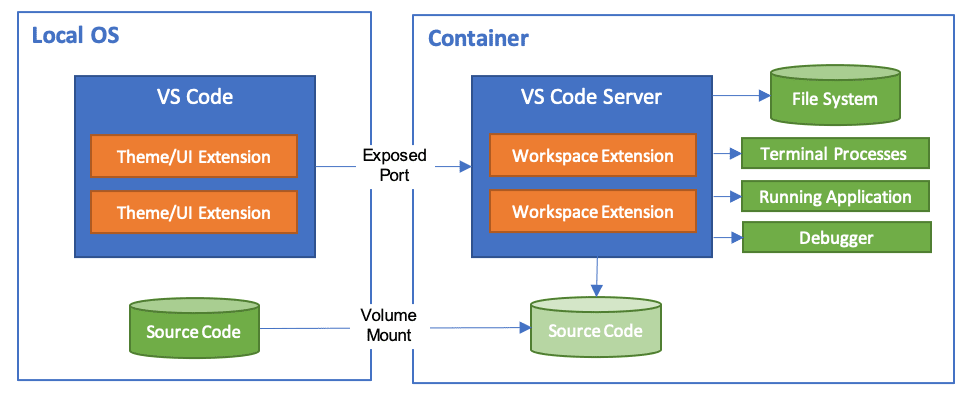
# [Visual Studio inside container](https://code.visualstudio.com/docs/devcontainers/containers)
[video TW](https://www.youtube.com/watch?v=3xtN129sOXY&t=40s)
# [Visual Studio inside container](https://code.visualstudio.com/docs/devcontainers/containers)

 [anchovy quality and drying](https://blog.tridge.com/blog-posts/dried-common-anchovy-procurement-intelligence-2026-cost-drivers-risk-triggers-and-practical-control-points)
## [Dev Containers tutorial](https://podman-desktop.io/blog/2025/05/05/vs-code-with-podman-desktop)
[anchovy quality and drying](https://blog.tridge.com/blog-posts/dried-common-anchovy-procurement-intelligence-2026-cost-drivers-risk-triggers-and-practical-control-points)
## [Dev Containers tutorial](https://podman-desktop.io/blog/2025/05/05/vs-code-with-podman-desktop)
 # Make fresh yeast
- dry yeast (5gr)
- distilled water ( 30ml)
- 00 type flour (60 gr)
Talas and Banggkuang untuk diabetes
# Nanobuble and Bounolli principle
- vortex
- Bournolli Principle
-
# [Venturi pump for oxygenator](https://aquaculturefrance.com/en/)
# Make fresh yeast
- dry yeast (5gr)
- distilled water ( 30ml)
- 00 type flour (60 gr)
Talas and Banggkuang untuk diabetes
# Nanobuble and Bounolli principle
- vortex
- Bournolli Principle
-
# [Venturi pump for oxygenator](https://aquaculturefrance.com/en/)


 # [Airlift pump vs pump](https://aquaculturemag.com/2023/12/25/engineered-airlift-pumps-can-help-aquaculture-systems-to-perform-better/)
 [airlift 300x](https://www.reddit.com/r/Aquaculture/comments/1qd63bx/100x_cheaper_simpler_and_more_reliable_than_pumps/)
 https://www.aesweb.org/files/Webinars/RAStech_2022_Presentation_3_Briquet.pdf
https://repository.lsu.edu/cgi/viewcontent.cgi?article=3941&context=gradschool_theses
## [Traditional airlift pumps](https://www.globalseafood.org/advocate/rectangular-airlift-pump-design-outperforms-cylindrical-units/)
The traditional airlift pump injects air into a cylindrical chamber/pipe that is partially or fully submerged in a fluid, typically water.
The air is injected into the fluid-filled cylinder at the side or in the center of the cylinder, above the intake.
The cylinder acts as a mixing chamber for the water and injected air.
In a 1994 World Aquaculture article, the author explained that the air-water mixture is less dense than, and therefore displaced by,
the surrounding water. The air-water mixture is forced out of the mixing chamber and through the discharge outlet at the top of the cylinder.
A steady flow of injected air produces a constant air-water mixture that is continually pushed to the surface and creates the pumping action of the airlift pump.
Pumping rates in airlift pumps are limited by cylinder diameter and the air injection methods required for cylindrical mixing chambers. To increase
flow rates beyond a single cylinder’s capacity, the output of several cylinders must be combined. This requires a cumbersome assembly of multiple airlift
cylinders that must be connected with potentially significant space requirements. Each cylinder needs its own independent air injector and, as a result,
an extensive air delivery system is necessary.
For any given air flow rate, friction and inline pressure increase as the length of the air distribution pipe (delivery system) increases. Essentially,
the efficiency of air delivery to the pumping cylinders drops as the size of the air distribution system is increased to include multiple airlift cylinders.
A single, compact and efficient airlift with high-volume output would be desirable.
## Rectangular airlifts
The geometry of a rectangular riser has some advantages over cylinders for building airlift pumps. Cylinders and square tubes have the same surface area:volume ratio when the diameter of the cylinder equals the length of the square’s sides. But when a rectangular riser is used, the surface area:volume ratio can be much lower than those of cylinders and square tubes, depending on the dimensions of the rectangle. The larger the dimensions of the rectangular perimeter, the lower the surface area:volume ratio becomes.
For a rectangular riser with perimeter dimensions large enough to tightly encompass 40 cylinders, the surface area:volume ratio would be five times less than that for the 40 cylinders combined (Table 1). Furthermore, if made of the same material, 40 cylinders would be over four times heavier than the rectangular riser. Surface area is important with respect to fluid flow and resistance. As surface area increases, resistance to fluid flow increases. A lower surface area:volume ratio means less fluid resistance, and higher flow rates are possible.
- RAS use pumps 90%, airlift pump 10%
- [airlift pump use in water recirulation (300x ?/day)](https://www.raschile.cl/copia-de-reuse)
- lift ideally 20-30cm, maximum 50-70cm
- can not use in wash drum filter
- saturated the water with oxygen and degass CO2
- not efficient
- air-to-water ratio 1:1 or max 1.5 : 1
- compressor use rotary instead of vortex compressor
- Prepeller pumps
# [Waterfall turbine](https://www.wdpower.co.za/water-turbine-power-generation/)
https://www.aesweb.org/files/Webinars/RAStech_2022_Presentation_3_Briquet.pdf
https://repository.lsu.edu/cgi/viewcontent.cgi?article=3941&context=gradschool_theses
## [Traditional airlift pumps](https://www.globalseafood.org/advocate/rectangular-airlift-pump-design-outperforms-cylindrical-units/)
The traditional airlift pump injects air into a cylindrical chamber/pipe that is partially or fully submerged in a fluid, typically water.
The air is injected into the fluid-filled cylinder at the side or in the center of the cylinder, above the intake.
The cylinder acts as a mixing chamber for the water and injected air.
In a 1994 World Aquaculture article, the author explained that the air-water mixture is less dense than, and therefore displaced by,
the surrounding water. The air-water mixture is forced out of the mixing chamber and through the discharge outlet at the top of the cylinder.
A steady flow of injected air produces a constant air-water mixture that is continually pushed to the surface and creates the pumping action of the airlift pump.
Pumping rates in airlift pumps are limited by cylinder diameter and the air injection methods required for cylindrical mixing chambers. To increase
flow rates beyond a single cylinder’s capacity, the output of several cylinders must be combined. This requires a cumbersome assembly of multiple airlift
cylinders that must be connected with potentially significant space requirements. Each cylinder needs its own independent air injector and, as a result,
an extensive air delivery system is necessary.
For any given air flow rate, friction and inline pressure increase as the length of the air distribution pipe (delivery system) increases. Essentially,
the efficiency of air delivery to the pumping cylinders drops as the size of the air distribution system is increased to include multiple airlift cylinders.
A single, compact and efficient airlift with high-volume output would be desirable.
## Rectangular airlifts
The geometry of a rectangular riser has some advantages over cylinders for building airlift pumps. Cylinders and square tubes have the same surface area:volume ratio when the diameter of the cylinder equals the length of the square’s sides. But when a rectangular riser is used, the surface area:volume ratio can be much lower than those of cylinders and square tubes, depending on the dimensions of the rectangle. The larger the dimensions of the rectangular perimeter, the lower the surface area:volume ratio becomes.
For a rectangular riser with perimeter dimensions large enough to tightly encompass 40 cylinders, the surface area:volume ratio would be five times less than that for the 40 cylinders combined (Table 1). Furthermore, if made of the same material, 40 cylinders would be over four times heavier than the rectangular riser. Surface area is important with respect to fluid flow and resistance. As surface area increases, resistance to fluid flow increases. A lower surface area:volume ratio means less fluid resistance, and higher flow rates are possible.
- RAS use pumps 90%, airlift pump 10%
- [airlift pump use in water recirulation (300x ?/day)](https://www.raschile.cl/copia-de-reuse)
- lift ideally 20-30cm, maximum 50-70cm
- can not use in wash drum filter
- saturated the water with oxygen and degass CO2
- not efficient
- air-to-water ratio 1:1 or max 1.5 : 1
- compressor use rotary instead of vortex compressor
- Prepeller pumps
# [Waterfall turbine](https://www.wdpower.co.za/water-turbine-power-generation/)
 - Head high : 40m
- Flow rate : 20l/s
- Generater 70% efficiency turbine: 8kW --> useable: 5.6 kW
Pw = 1000 ( kg/m ³) * 9.81 (m/s²) * 40 (m) * 0.02 (m³/s)
Pw = 8000 Watts
Pw = 8 kW (Potential Power)
Pe = Pw * η
So, if your estimated efficiency is 70% (or 0.7):
Pe = 8 kW * 0.7
Pe = 5.6 kW (Estimated Electrical Power)
[micro hydropower](https://www.sunecohydro.com/hydro-power-stations/)
- Head high : 40m
- Flow rate : 20l/s
- Generater 70% efficiency turbine: 8kW --> useable: 5.6 kW
Pw = 1000 ( kg/m ³) * 9.81 (m/s²) * 40 (m) * 0.02 (m³/s)
Pw = 8000 Watts
Pw = 8 kW (Potential Power)
Pe = Pw * η
So, if your estimated efficiency is 70% (or 0.7):
Pe = 8 kW * 0.7
Pe = 5.6 kW (Estimated Electrical Power)
[micro hydropower](https://www.sunecohydro.com/hydro-power-stations/)
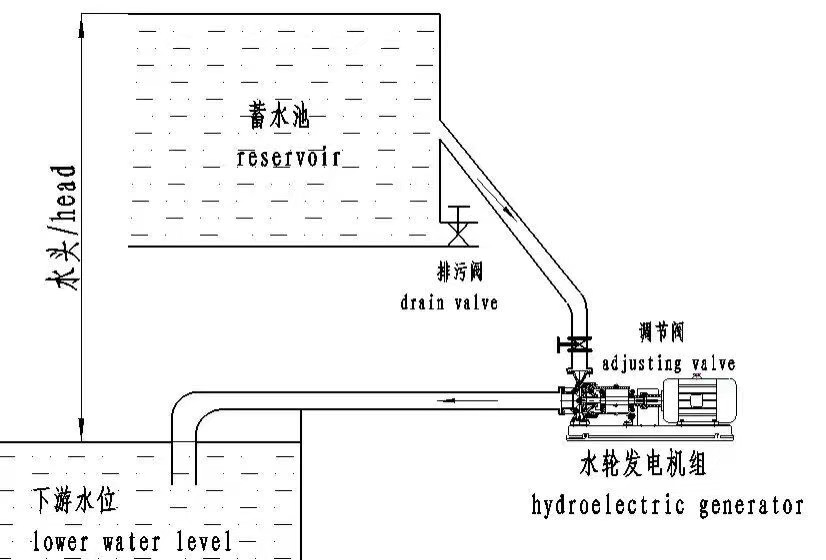 [video hydropower](https://www.youtube.com/watch?v=KEsrAmM07fs)
# [Freeze drying is the removal of water by sublimation from the frozen state (ice).](https://www.ellab.com/wp-content/uploads/2020/08/the-freeze-drying-theory-and-process_ellab-whitepaper.pdf)
In this process, the food is first frozen and then subjected to a high vacuum, whereby the water ice evaporates without melting.
The water vapor released is condensed on the surface of a condenser at very low temperature. The heat needed for sublimation is supplied by radiation or conduction.
Freeze drying occurs in two stages: sublimation of the ice, and desorption of the moisture adsorbed in the dry matrix.
A model for lyophilization kinetics in a greatly simplified system is developed. Applications of freeze drying in the food industry are reviewed, and batch and continuous
freeze dryers are described. Microwave freeze drying is discussed.
Freeze concentration is the removal of water from a frozen food liquid as ice crystals. Since freeze concentration occurs without heating or boiling, thermal damage and
loss of volatile aromas are largely avoided. The main disadvantage of freeze concentration is the loss of solute, which may be considerable at high concentration ratio.
PRODUCTS BEING FREEZE DRIED:
Pharmaceuticals
Homeopathic Remedies
Camping Food
Pet Food
Coffee
Mushrooms
Guacamole/Salsa
Herbs
Fruits & Veggies
Meats
Fish
Ice Cream
Eggs
Baby Food
Easy-to-make Meals
Soups
Cannabis & Related Products
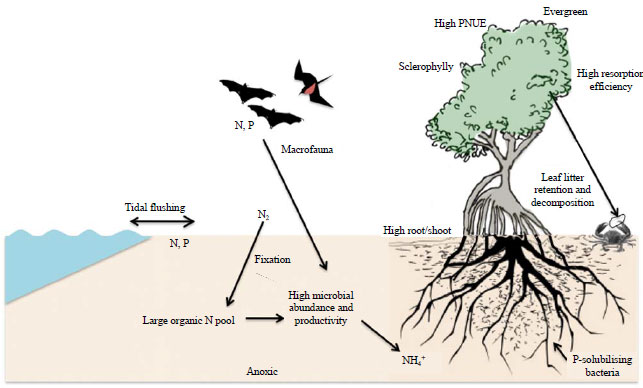
mangrove soils
[video hydropower](https://www.youtube.com/watch?v=KEsrAmM07fs)
# [Freeze drying is the removal of water by sublimation from the frozen state (ice).](https://www.ellab.com/wp-content/uploads/2020/08/the-freeze-drying-theory-and-process_ellab-whitepaper.pdf)
In this process, the food is first frozen and then subjected to a high vacuum, whereby the water ice evaporates without melting.
The water vapor released is condensed on the surface of a condenser at very low temperature. The heat needed for sublimation is supplied by radiation or conduction.
Freeze drying occurs in two stages: sublimation of the ice, and desorption of the moisture adsorbed in the dry matrix.
A model for lyophilization kinetics in a greatly simplified system is developed. Applications of freeze drying in the food industry are reviewed, and batch and continuous
freeze dryers are described. Microwave freeze drying is discussed.
Freeze concentration is the removal of water from a frozen food liquid as ice crystals. Since freeze concentration occurs without heating or boiling, thermal damage and
loss of volatile aromas are largely avoided. The main disadvantage of freeze concentration is the loss of solute, which may be considerable at high concentration ratio.
PRODUCTS BEING FREEZE DRIED:
Pharmaceuticals
Homeopathic Remedies
Camping Food
Pet Food
Coffee
Mushrooms
Guacamole/Salsa
Herbs
Fruits & Veggies
Meats
Fish
Ice Cream
Eggs
Baby Food
Easy-to-make Meals
Soups
Cannabis & Related Products
mangrove soils
 https://i0.wp.com/randomnerdtutorials.com/wp-content/uploads/2017/03/DHT22_RaspberryPi_ESP8266.jpg?quality=100&strip=all&ssl=1
# [Nanopb](https://jpa.kapsi.fi/nanopb/)
# What is distilled water?
Distilled water is a highly purified form of water that has been stripped of almost all of its impurities,
including minerals, salts, and other organic and inorganic compounds. Through the process of distillation, water is boiled,
turned into steam, and then cooled and condensed back into a liquid state. This process leaves behind contaminants,
resulting in water that is essentially pure H₂O.
How is distilled water made?
The process of creating distilled water mimics the natural water cycle and involves these key steps:
Boiling: Tap water or spring water is heated in a boiler until it reaches its boiling point and transforms into steam.
Evaporation: As the water evaporates into steam, it leaves behind dissolved solids, such as salts, minerals (like calcium and magnesium), and other non-volatile contaminants.
Condensation: The steam is then channeled into a separate cooling system or condenser. As the steam cools, it reverts to its liquid form.
Collection: The resulting liquid, now distilled water, is collected in a clean, sterile container.
What is the difference between distilled and purified water?
While both are clean forms of drinking water, there is a key distinction:
Distilled Water: This is a type of purified water that is created through the specific process of distillation (boiling and condensing).
This process removes nearly all minerals and other impurities.
Purified Water: This is a broader category of water that has been treated to remove impurities. Purification methods can include distillation,
reverse osmosis, deionization, or carbon filtration. The key difference is that some purification methods may not remove all minerals as effectively as distillation.
For water to be labeled as "purified," it must meet certain standards of purity, but it is not necessarily mineral-free.
https://www.axilscientific.com/products/chemicals/biological-buffers/2x-laemmli-sample-buffer-ph-68-biotechnology-grade-p-buf-5240.html
# Modbus sensors
are industrial devices using the standard Modbus protocol for digital communication, allowing them to send accurate data (like temperature, humidity, pressure, air quality)
over networks (RS485, TCP) to controllers (PLCs, BMS) using simple, cost-effective cabling, enabling daisy-chaining up to 247 devices for efficient data exchange in automation systems,
unlike analog sensors that need separate wiring for each signal.
[modbus esphome -1](https://esphome.io/components/modbus_controller/)
[modbus esphome -2 ](https://esphome.io/components/modbus/)
[esphome yaml modbus](https://github.com/mortenx/modbustcp_wifi_esphome/tree/60959a6fdde990ced413398072f1628c7e513b23)
[esphome in python](https://github.com/esphome/esphome/tree/dev/esphome)
https://ioninja.com/downloads/archive/ioninja/ioninja-5.9.1/
https://www.segger.com/products/debug-probes/j-link/technology/about-real-time-transfer/
STC-3008 Dual Digital Temperature Controller Two Relay Output 12V 24V 220V Thermoregulator Thermostat Heater Cooler With Probe
STC-3008 Dual Relay Digital Thermostat Controller NTC Sensor 12V 24V 110V 220V Adjustable Heating Cooling Switch
STC-8080A+ Refrigeration Temperature Controller Digital Thermostat for Freezer Cold Storage Defrost Fridge Use
Refrigeration Temperature Controller STC 8080A with Cooling Defrost and Over Temperature Alarm for Freezer Cold Room
STC-9200A/EK-3030 Temperature Controller for Refrigeration and Defrost Fans
Stainless Steel Electric Heating Tube 220V High-Temperature Grill & Oven Heater Rod for BBQ and Industrial Equipment
220V Digital Temperature Controller EK-3010/EK-3020/EK-3030 Refrigerator Refrigeration Defrost Thermostat Sensor
Upgraded heating cable transparent floor heating wire 100m 12K 33 ohm / M carbon electric heating cable
5/10/20/25/50/200/500/1000ml Class A Borosilicate Glass Lab Clear Volumetric Flask With Head Stopper
Yieryi MH1230A AC220V Digital Temperature Controller Thermocouple -40 ~ 120 Degrees Thermostat Refrigeration Heating Regulator
pH 4
Potassium Citrate 2.63g
Citric acid monohydrate 3.45g
(if using anhydrous citric acid, use 3.15g)
pH 7
Potassium Citrate 7.14g
Citric acid monohydrate 0.35g
(if using anhydrous citric acid, use 0.32g)
Class A Volumetric Flask (250mL)
LiveSeafood, [1/14/26 10:12 PM]
Excellent question. Preparing precise pH buffers from food-grade ingredients is a common need in food science, home brewing, and artisanal fermentation labs. While "food-grade" limits the chemicals we can use, we can achieve good approximations.
Critical Note: Food-grade chemicals have lower purity (typically 97-99%) than lab-grade (>99.9%). This, along with variations in mineral content of water, will affect the absolute accuracy. For critical work, always verify the pH with a recently calibrated meter.
Here are the calculations and methods for the three buffers at 25°C.
---
1. pH 4.01 Buffer (Potassium Hydrogen Phthalate, 0.05M)
This is the most straightforward, as the primary ingredient is available as a pH standard in food-grade form.
· Food-Grade Ingredient: Potassium Hydrogen Phthalate (KHP). It's commonly used as an acidulant and stabilizer (E336).
· Formula: KHC₈H₄O₄
· Molecular Weight: 204.22 g/mol
Calculation for 1 Liter of 0.05M Solution:
Moles = Molarity × Volume = 0.05 mol/L × 1 L = 0.05 mol
Mass = Moles × Molecular Weight = 0.05 mol × 204.22 g/mol = 10.211 g
Preparation:
1. Weigh 10.21 grams of food-grade potassium hydrogen phthalate.
2. Dissolve it in high-purity, deionized or distilled water (not tap water).
3. Transfer to a 1-liter volumetric flask and fill to the mark with water. Mix thoroughly.
4. The pH should be 4.01 at 25°C. It changes slightly with temperature (~ -0.0012 pH/°C).
---
2. pH 6.86 Buffer (Equimolar Phosphate Buffer)
This buffer uses two salts. The dihydrogen phosphate is available food-grade; the hydrogen phosphate might need sourcing from a chemical supplier as a food additive (E339).
· Food-Grade Ingredients:
· Monopotassium Phosphate (KH₂PO₄) - (E340) Common in food processing.
· Disodium Phosphate (Na₂HPO₄) - (E339) Also common. Using sodium instead of potassium salts is standard for this buffer.
· Formula & MW:
· KH₂PO₄ = 136.09 g/mol
· Na₂HPO₄ (anhydrous) = 141.96 g/mol. (Note: The more common form is the dihydrate, Na₂HPO₄·2H₂O, MW = 177.99 g/mol. Ensure you know which you have!)
Calculation for 1 Liter of 0.025M Equimolar Buffer:
· Both salts are at 0.025M concentration.
· Mass of KH₂PO₄: 0.025 mol × 136.09 g/mol = 3.402 g
· Mass of Na₂HPO₄ (Anhydrous): 0.025 mol × 141.96 g/mol = 3.549 g
· Mass of Na₂HPO₄·2H₂O (Dihydrate): 0.025 mol × 177.99 g/mol = 4.450 g
Preparation (using the more common dihydrate):
1. Weigh 3.402 g of monopotassium phosphate (KH₂PO₄).
2. Weigh 4.450 g of disodium phosphate dihydrate (Na₂HPO₄·2H₂O).
3. Dissolve both salts together in high-purity water.
4. Transfer to a 1-liter volumetric flask, fill to the mark, and mix. pH = 6.86 at 25°C.
---
3. pH 9.18 Buffer (Borax Buffer) - The Challenge
This is the most problematic. The classic buffer for pH ~9.2 is Sodium Tetraborate Decahydrate (Borax, Na₂B₄O₇·10H₂O).
· Issue: Borax's food-grade status is controversial and it is not approved as a food additive in many jurisdictions (e.g., EU, US). It is sometimes used as a washing aid but not for direct consumption.
Alternative Food-Grade Buffer for High pH: Bicarbonate/Carbonate Buffer
A 0.025M Sodium Bicarbonate / 0.025M Sodium Carbonate buffer gives a pH of approximately 9.91 at 25°C, not 9.18. To get to 9.18, we need to adjust the ratio.
· Food-Grade Ingredients:
· Sodium Bicarbonate (NaHCO₃) - Baking soda.
· Sodium Carbonate (Na₂CO₃) - Soda ash, washing soda (can be made by heating baking soda at 170°C for 1 hour).
Calculation to Approximate pH 9.18:
Using the Henderson-Hasselbalch equation for the carbonate system (pKa2 = 10.33 at 25°C):
pH = pKa2 + log([CO₃²⁻]/[HCO₃⁻])
9.18 = 10.33 + log(R) where R = [CO₃²⁻]/[HCO₃⁻]
log(R) = 9.18 - 10.33 = -1.15
R = 10⁻¹·¹⁵ = 0.0708
This means the buffer needs a much higher proportion of bicarbonate. Let's make a 0.05M total carbonate buffer.
· Let [HCO₃⁻] = x, then [CO₃²⁻] = 0.0708x
· Total carbonate = x + 0.0708x = 0.05 M
· 1.0708x = 0.05 → x = 0.0467 M (HCO₃⁻)
· [CO₃²⁻] = 0.05 - 0.0467 = 0.0033 M
Masses for 1 Liter:
· NaHCO₃: 0.0467 mol × 84.01 g/mol = 3.923 g
· Na₂CO₃ (anhydrous): 0.
LiveSeafood, [1/14/26 10:12 PM]
0033 mol × 105.99 g/mol = 0.350 g
Preparation (Approximate pH 9.18 Buffer):
1. Dry your sodium bicarbonate in an oven (~100°C) for 30 minutes to remove moisture. Cool in a desiccator.
2. Weigh 3.92 g of dried sodium bicarbonate.
3. Weigh 0.35 g of anhydrous sodium carbonate.
4. Dissolve both in CO₂-free, high-purity water (boil and cool water to remove CO₂).
5. Transfer to a 1-liter volumetric flask, fill to the mark with the CO₂-free water, and mix without vigorous shaking to minimize CO₂ absorption.
6. VERIFY WITH A CALIBRATED METER. Expect some drift as the solution equilibrates with air.
---
https://i0.wp.com/randomnerdtutorials.com/wp-content/uploads/2017/03/DHT22_RaspberryPi_ESP8266.jpg?quality=100&strip=all&ssl=1
# [Nanopb](https://jpa.kapsi.fi/nanopb/)
# What is distilled water?
Distilled water is a highly purified form of water that has been stripped of almost all of its impurities,
including minerals, salts, and other organic and inorganic compounds. Through the process of distillation, water is boiled,
turned into steam, and then cooled and condensed back into a liquid state. This process leaves behind contaminants,
resulting in water that is essentially pure H₂O.
How is distilled water made?
The process of creating distilled water mimics the natural water cycle and involves these key steps:
Boiling: Tap water or spring water is heated in a boiler until it reaches its boiling point and transforms into steam.
Evaporation: As the water evaporates into steam, it leaves behind dissolved solids, such as salts, minerals (like calcium and magnesium), and other non-volatile contaminants.
Condensation: The steam is then channeled into a separate cooling system or condenser. As the steam cools, it reverts to its liquid form.
Collection: The resulting liquid, now distilled water, is collected in a clean, sterile container.
What is the difference between distilled and purified water?
While both are clean forms of drinking water, there is a key distinction:
Distilled Water: This is a type of purified water that is created through the specific process of distillation (boiling and condensing).
This process removes nearly all minerals and other impurities.
Purified Water: This is a broader category of water that has been treated to remove impurities. Purification methods can include distillation,
reverse osmosis, deionization, or carbon filtration. The key difference is that some purification methods may not remove all minerals as effectively as distillation.
For water to be labeled as "purified," it must meet certain standards of purity, but it is not necessarily mineral-free.
https://www.axilscientific.com/products/chemicals/biological-buffers/2x-laemmli-sample-buffer-ph-68-biotechnology-grade-p-buf-5240.html
# Modbus sensors
are industrial devices using the standard Modbus protocol for digital communication, allowing them to send accurate data (like temperature, humidity, pressure, air quality)
over networks (RS485, TCP) to controllers (PLCs, BMS) using simple, cost-effective cabling, enabling daisy-chaining up to 247 devices for efficient data exchange in automation systems,
unlike analog sensors that need separate wiring for each signal.
[modbus esphome -1](https://esphome.io/components/modbus_controller/)
[modbus esphome -2 ](https://esphome.io/components/modbus/)
[esphome yaml modbus](https://github.com/mortenx/modbustcp_wifi_esphome/tree/60959a6fdde990ced413398072f1628c7e513b23)
[esphome in python](https://github.com/esphome/esphome/tree/dev/esphome)
https://ioninja.com/downloads/archive/ioninja/ioninja-5.9.1/
https://www.segger.com/products/debug-probes/j-link/technology/about-real-time-transfer/
STC-3008 Dual Digital Temperature Controller Two Relay Output 12V 24V 220V Thermoregulator Thermostat Heater Cooler With Probe
STC-3008 Dual Relay Digital Thermostat Controller NTC Sensor 12V 24V 110V 220V Adjustable Heating Cooling Switch
STC-8080A+ Refrigeration Temperature Controller Digital Thermostat for Freezer Cold Storage Defrost Fridge Use
Refrigeration Temperature Controller STC 8080A with Cooling Defrost and Over Temperature Alarm for Freezer Cold Room
STC-9200A/EK-3030 Temperature Controller for Refrigeration and Defrost Fans
Stainless Steel Electric Heating Tube 220V High-Temperature Grill & Oven Heater Rod for BBQ and Industrial Equipment
220V Digital Temperature Controller EK-3010/EK-3020/EK-3030 Refrigerator Refrigeration Defrost Thermostat Sensor
Upgraded heating cable transparent floor heating wire 100m 12K 33 ohm / M carbon electric heating cable
5/10/20/25/50/200/500/1000ml Class A Borosilicate Glass Lab Clear Volumetric Flask With Head Stopper
Yieryi MH1230A AC220V Digital Temperature Controller Thermocouple -40 ~ 120 Degrees Thermostat Refrigeration Heating Regulator
pH 4
Potassium Citrate 2.63g
Citric acid monohydrate 3.45g
(if using anhydrous citric acid, use 3.15g)
pH 7
Potassium Citrate 7.14g
Citric acid monohydrate 0.35g
(if using anhydrous citric acid, use 0.32g)
Class A Volumetric Flask (250mL)
LiveSeafood, [1/14/26 10:12 PM]
Excellent question. Preparing precise pH buffers from food-grade ingredients is a common need in food science, home brewing, and artisanal fermentation labs. While "food-grade" limits the chemicals we can use, we can achieve good approximations.
Critical Note: Food-grade chemicals have lower purity (typically 97-99%) than lab-grade (>99.9%). This, along with variations in mineral content of water, will affect the absolute accuracy. For critical work, always verify the pH with a recently calibrated meter.
Here are the calculations and methods for the three buffers at 25°C.
---
1. pH 4.01 Buffer (Potassium Hydrogen Phthalate, 0.05M)
This is the most straightforward, as the primary ingredient is available as a pH standard in food-grade form.
· Food-Grade Ingredient: Potassium Hydrogen Phthalate (KHP). It's commonly used as an acidulant and stabilizer (E336).
· Formula: KHC₈H₄O₄
· Molecular Weight: 204.22 g/mol
Calculation for 1 Liter of 0.05M Solution:
Moles = Molarity × Volume = 0.05 mol/L × 1 L = 0.05 mol
Mass = Moles × Molecular Weight = 0.05 mol × 204.22 g/mol = 10.211 g
Preparation:
1. Weigh 10.21 grams of food-grade potassium hydrogen phthalate.
2. Dissolve it in high-purity, deionized or distilled water (not tap water).
3. Transfer to a 1-liter volumetric flask and fill to the mark with water. Mix thoroughly.
4. The pH should be 4.01 at 25°C. It changes slightly with temperature (~ -0.0012 pH/°C).
---
2. pH 6.86 Buffer (Equimolar Phosphate Buffer)
This buffer uses two salts. The dihydrogen phosphate is available food-grade; the hydrogen phosphate might need sourcing from a chemical supplier as a food additive (E339).
· Food-Grade Ingredients:
· Monopotassium Phosphate (KH₂PO₄) - (E340) Common in food processing.
· Disodium Phosphate (Na₂HPO₄) - (E339) Also common. Using sodium instead of potassium salts is standard for this buffer.
· Formula & MW:
· KH₂PO₄ = 136.09 g/mol
· Na₂HPO₄ (anhydrous) = 141.96 g/mol. (Note: The more common form is the dihydrate, Na₂HPO₄·2H₂O, MW = 177.99 g/mol. Ensure you know which you have!)
Calculation for 1 Liter of 0.025M Equimolar Buffer:
· Both salts are at 0.025M concentration.
· Mass of KH₂PO₄: 0.025 mol × 136.09 g/mol = 3.402 g
· Mass of Na₂HPO₄ (Anhydrous): 0.025 mol × 141.96 g/mol = 3.549 g
· Mass of Na₂HPO₄·2H₂O (Dihydrate): 0.025 mol × 177.99 g/mol = 4.450 g
Preparation (using the more common dihydrate):
1. Weigh 3.402 g of monopotassium phosphate (KH₂PO₄).
2. Weigh 4.450 g of disodium phosphate dihydrate (Na₂HPO₄·2H₂O).
3. Dissolve both salts together in high-purity water.
4. Transfer to a 1-liter volumetric flask, fill to the mark, and mix. pH = 6.86 at 25°C.
---
3. pH 9.18 Buffer (Borax Buffer) - The Challenge
This is the most problematic. The classic buffer for pH ~9.2 is Sodium Tetraborate Decahydrate (Borax, Na₂B₄O₇·10H₂O).
· Issue: Borax's food-grade status is controversial and it is not approved as a food additive in many jurisdictions (e.g., EU, US). It is sometimes used as a washing aid but not for direct consumption.
Alternative Food-Grade Buffer for High pH: Bicarbonate/Carbonate Buffer
A 0.025M Sodium Bicarbonate / 0.025M Sodium Carbonate buffer gives a pH of approximately 9.91 at 25°C, not 9.18. To get to 9.18, we need to adjust the ratio.
· Food-Grade Ingredients:
· Sodium Bicarbonate (NaHCO₃) - Baking soda.
· Sodium Carbonate (Na₂CO₃) - Soda ash, washing soda (can be made by heating baking soda at 170°C for 1 hour).
Calculation to Approximate pH 9.18:
Using the Henderson-Hasselbalch equation for the carbonate system (pKa2 = 10.33 at 25°C):
pH = pKa2 + log([CO₃²⁻]/[HCO₃⁻])
9.18 = 10.33 + log(R) where R = [CO₃²⁻]/[HCO₃⁻]
log(R) = 9.18 - 10.33 = -1.15
R = 10⁻¹·¹⁵ = 0.0708
This means the buffer needs a much higher proportion of bicarbonate. Let's make a 0.05M total carbonate buffer.
· Let [HCO₃⁻] = x, then [CO₃²⁻] = 0.0708x
· Total carbonate = x + 0.0708x = 0.05 M
· 1.0708x = 0.05 → x = 0.0467 M (HCO₃⁻)
· [CO₃²⁻] = 0.05 - 0.0467 = 0.0033 M
Masses for 1 Liter:
· NaHCO₃: 0.0467 mol × 84.01 g/mol = 3.923 g
· Na₂CO₃ (anhydrous): 0.
LiveSeafood, [1/14/26 10:12 PM]
0033 mol × 105.99 g/mol = 0.350 g
Preparation (Approximate pH 9.18 Buffer):
1. Dry your sodium bicarbonate in an oven (~100°C) for 30 minutes to remove moisture. Cool in a desiccator.
2. Weigh 3.92 g of dried sodium bicarbonate.
3. Weigh 0.35 g of anhydrous sodium carbonate.
4. Dissolve both in CO₂-free, high-purity water (boil and cool water to remove CO₂).
5. Transfer to a 1-liter volumetric flask, fill to the mark with the CO₂-free water, and mix without vigorous shaking to minimize CO₂ absorption.
6. VERIFY WITH A CALIBRATED METER. Expect some drift as the solution equilibrates with air.
---
 Summary Table for 1L Buffer Solutions
Target pH Food-Grade Ingredients Quantities for 1L (at 25°C) Notes
4.01 Potassium Hydrogen Phthalate (KHP) 10.21 g Most accurate & reliable food-grade option.
6.86 Monopotassium Phosphate (KH₂PO₄) + Disodium Phosphate Dihydrate (Na₂HPO₄·2H₂O) 3.402 g + 4.450 g Standard phosphate buffer. Good stability.
~9.18 Sodium Bicarbonate (NaHCO₃) + Sodium Carbonate (Na₂CO₃) 3.92 g + 0.35 g Approximation. Sensitive to CO₂. Verify pH.
General Preparation Protocol:
1. Use Precise Equipment: Analytical balance (0.01g min) and volumetric glassware.
2. Use Pure Water: Always use distilled or deionized water. For pH 9+ buffers, boil and cool it to remove CO₂.
3. Temperature: The pH of buffers is temperature-dependent. The values above are for 25°C. Allow solutions to reach room temperature before final verification.
4. Calibration: Calibrate your pH meter using commercial, traceable pH 4.01 and 7.00 buffers first. Then measure your prepared buffers.
5. Storage: Store in airtight, chemical-resistant bottles (HDPE or glass). Phosphate buffer is susceptible to microbial growth; refrigerate or make fresh frequently.
Disclaimer: These preparations are suitable for food science applications where trace impurities are acceptable. For regulatory compliance or absolute analytical precision,
certified buffer solutions or lab-grade chemicals are required.
[buffer solution for calibration](https://www.yokogawa.com/sg/solutions/products-and-services/measurement/analyzers/liquid-analyzers/ph-sensors/ph-orp-buffer-calibration-solutions-buffer-capsules/#Resources)
## [FDR (Frequency Domain Reflectometry)- soil](https://www.sciencedirect.com/topics/engineering/domain-reflectometry)
https://www.aliexpress.com/item/1005009437373461.html?spm=a2g0o.detail.pcDetailBottomMoreOtherSeller.2.37cajCwqjCwqUC&gps-id=pcDetailBottomMoreOtherSeller&scm=1007.40050.354490.0&scm_id=1007.40050.354490.0&scm-url=1007.40050.354490.0&pvid=abb75415-dc9d-4c38-8539-0b7fb4e38954&_t=gps-id:pcDetailBottomMoreOtherSeller,scm-url:1007.40050.354490.0,pvid:abb75415-dc9d-4c38-8539-0b7fb4e38954,tpp_buckets:668%232846%238116%232002&isseo=y&pdp_ext_f=%7B%22order%22%3A%2235%22%2C%22eval%22%3A%221%22%2C%22sceneId%22%3A%2230050%22%2C%22fromPage%22%3A%22recommend%22%7D&pdp_npi=6%40dis%21SGD%2131.09%2119.90%21%21%21163.52%21104.65%21%402102eaa317683497537194929e5259%2112000049099411629%21rec%21SG%21775789526%21X%211%210%21n_tag%3A-29919%3Bd%3Aaaab9621%3Bm03_new_user%3A-29895&utparam-url=scene%3ApcDetailBottomMoreOtherSeller%7Cquery_from%3A%7Cx_object_id%3A1005009437373461%7C_p_origin_prod%3A#nav-specification
https://zlj490490.en.made-in-china.com/
## [Modbus RTU](https://www.jxct-iot.com/product/showproduct.php?id=208)
Modbus RTU (Remote Terminal Unit) is the most widely used version of Modbus. It operates over serial communication lines like RS-485 or RS-232.
The RTU format includes a cyclic redundancy check (CRC) for error checking,
ensuring reliable data transmission. It is particularly favored for its simplicity and robustness in harsh industrial environments.
```
#include "cpplinq.hpp"
using namespace cpplinq;
void setup() {
Serial.begin(115200);
int ints[] = {5,7,4,7,8,15,9,25,15,14,30,9,24,5,78,912,37,48,980,200,201};
int result = from_array(ints)
>> where([](int i) {return i%2 == 0;})
>> where([](int i) {return i < 100;})
>> max();
Serial.println(result);
}
void loop() {}
```
# Frequency Ranges for Moisture Meters
The frequency range used in moisture meters depends on the material being tested (soil, fertilizer, coal, etc.) and the measurement technique. Here’s a detailed breakdown of the typical MHz frequencies used and why they matter:
Common Frequency Ranges for Moisture Meters
Frequency Range Application Advantages Limitations
1–20 MHz Soil, Fertilizers, Coal, Powders - Balances penetration depth & sensitivity.
Summary Table for 1L Buffer Solutions
Target pH Food-Grade Ingredients Quantities for 1L (at 25°C) Notes
4.01 Potassium Hydrogen Phthalate (KHP) 10.21 g Most accurate & reliable food-grade option.
6.86 Monopotassium Phosphate (KH₂PO₄) + Disodium Phosphate Dihydrate (Na₂HPO₄·2H₂O) 3.402 g + 4.450 g Standard phosphate buffer. Good stability.
~9.18 Sodium Bicarbonate (NaHCO₃) + Sodium Carbonate (Na₂CO₃) 3.92 g + 0.35 g Approximation. Sensitive to CO₂. Verify pH.
General Preparation Protocol:
1. Use Precise Equipment: Analytical balance (0.01g min) and volumetric glassware.
2. Use Pure Water: Always use distilled or deionized water. For pH 9+ buffers, boil and cool it to remove CO₂.
3. Temperature: The pH of buffers is temperature-dependent. The values above are for 25°C. Allow solutions to reach room temperature before final verification.
4. Calibration: Calibrate your pH meter using commercial, traceable pH 4.01 and 7.00 buffers first. Then measure your prepared buffers.
5. Storage: Store in airtight, chemical-resistant bottles (HDPE or glass). Phosphate buffer is susceptible to microbial growth; refrigerate or make fresh frequently.
Disclaimer: These preparations are suitable for food science applications where trace impurities are acceptable. For regulatory compliance or absolute analytical precision,
certified buffer solutions or lab-grade chemicals are required.
[buffer solution for calibration](https://www.yokogawa.com/sg/solutions/products-and-services/measurement/analyzers/liquid-analyzers/ph-sensors/ph-orp-buffer-calibration-solutions-buffer-capsules/#Resources)
## [FDR (Frequency Domain Reflectometry)- soil](https://www.sciencedirect.com/topics/engineering/domain-reflectometry)
https://www.aliexpress.com/item/1005009437373461.html?spm=a2g0o.detail.pcDetailBottomMoreOtherSeller.2.37cajCwqjCwqUC&gps-id=pcDetailBottomMoreOtherSeller&scm=1007.40050.354490.0&scm_id=1007.40050.354490.0&scm-url=1007.40050.354490.0&pvid=abb75415-dc9d-4c38-8539-0b7fb4e38954&_t=gps-id:pcDetailBottomMoreOtherSeller,scm-url:1007.40050.354490.0,pvid:abb75415-dc9d-4c38-8539-0b7fb4e38954,tpp_buckets:668%232846%238116%232002&isseo=y&pdp_ext_f=%7B%22order%22%3A%2235%22%2C%22eval%22%3A%221%22%2C%22sceneId%22%3A%2230050%22%2C%22fromPage%22%3A%22recommend%22%7D&pdp_npi=6%40dis%21SGD%2131.09%2119.90%21%21%21163.52%21104.65%21%402102eaa317683497537194929e5259%2112000049099411629%21rec%21SG%21775789526%21X%211%210%21n_tag%3A-29919%3Bd%3Aaaab9621%3Bm03_new_user%3A-29895&utparam-url=scene%3ApcDetailBottomMoreOtherSeller%7Cquery_from%3A%7Cx_object_id%3A1005009437373461%7C_p_origin_prod%3A#nav-specification
https://zlj490490.en.made-in-china.com/
## [Modbus RTU](https://www.jxct-iot.com/product/showproduct.php?id=208)
Modbus RTU (Remote Terminal Unit) is the most widely used version of Modbus. It operates over serial communication lines like RS-485 or RS-232.
The RTU format includes a cyclic redundancy check (CRC) for error checking,
ensuring reliable data transmission. It is particularly favored for its simplicity and robustness in harsh industrial environments.
```
#include "cpplinq.hpp"
using namespace cpplinq;
void setup() {
Serial.begin(115200);
int ints[] = {5,7,4,7,8,15,9,25,15,14,30,9,24,5,78,912,37,48,980,200,201};
int result = from_array(ints)
>> where([](int i) {return i%2 == 0;})
>> where([](int i) {return i < 100;})
>> max();
Serial.println(result);
}
void loop() {}
```
# Frequency Ranges for Moisture Meters
The frequency range used in moisture meters depends on the material being tested (soil, fertilizer, coal, etc.) and the measurement technique. Here’s a detailed breakdown of the typical MHz frequencies used and why they matter:
Common Frequency Ranges for Moisture Meters
Frequency Range Application Advantages Limitations
1–20 MHz Soil, Fertilizers, Coal, Powders - Balances penetration depth & sensitivity.- Minimizes ionic conductivity effects. - May still be affected by high salt content. 50–150 MHz High-Precision Agriculture, Industrial Materials - Better resolution for low-moisture materials.
- Less affected by density variations. - More expensive hardware. 200–1000 MHz (GHz range) Lab-Grade Analysis, Pharmaceuticals - Detects bound vs. free water.
- Works with very fine powders. - Limited field use due to complexity. Why These Frequencies? 1–20 MHz (Most Common for Portable Meters) Optimal for granular materials (soil, sand, fertilizer). Low enough to avoid excessive signal loss in conductive materials (e.g., salty soils). High enough to ignore electrode polarization errors (common in low-frequency meters). 50–150 MHz (Advanced Industrial Use) Used in precision agriculture and process control (e.g., coal moisture in power plants). Better for low-moisture powders (e.g., dry chemicals, cement). 200+ MHz (Research & Lab Instruments) Detects different water states (free vs. bound water). Used in pharmaceuticals and food science where exact moisture is critical. Key Considerations When Choosing a Frequency Material Type: Soil/Fertilizer: 5–50 MHz (avoids salt interference). Coal/Powders: 10–100 MHz (density-independent). Chemical Powders: 20–200 MHz (fine particles need higher frequencies). Moisture Range: High moisture (>20%) → Lower MHz (1–20 MHz). Low moisture (<5%) → Higher MHz (50+ MHz). Conductivity Effects: If the material is salty or conductive (e.g., some fertilizers), higher frequencies (50+ MHz) reduce errors. Best Practices for Moisture Measurement ✔ Use a meter with adjustable frequency if working with multiple materials. ✔ Calibrate for each material (fertilizer vs. coal vs. soil). ✔ Avoid very low frequencies (<1 MHz) if measuring conductive materials. Would you like recommendations for specific moisture meters based on your application? # [esp32](https://rust-dd.com/post/introduction-to-embedded-systems-with-rust-a-beginner-s-guide-using-esp32) - [esp-dsp module](https://github.com/espressif/esp-dsp/blob/master/examples/basic_math/main/dsps_math_main.c) - [Custom display](https://blog.embeddedexpert.io/?p=27650) or EEZ Studio,Squareline studio - generate cpp code LVGL - [include TFT_eSPI library](https://www.digikey.tw/zh/maker/projects/elecrow-crow-panel-2.8-esp32-hmi-display-simple-tft_espi-examples/e54c6083ba8a41ebb3da7c4efd33444e) - [FreeRTOS esp32](https://medium.com/@tomw3115/implementing-freertos-solutions-on-esp-32-devices-using-arduino-fa64c5d88605) - [free rtos esp32 and adriono](https://wolles-elektronikkiste.de/en/using-freertos-with-esp32-and-arduino) - [realtime kernel](https://homel.vsb.cz/~sta048/mcu/doc/freertos/Mastering-the-FreeRTOS-Real-Time-Kernel.v1.0.pdf) - [ESPHOME Aqqua](https://github.com/TheRealFalseReality/aquapi?tab=readme-ov-file) -
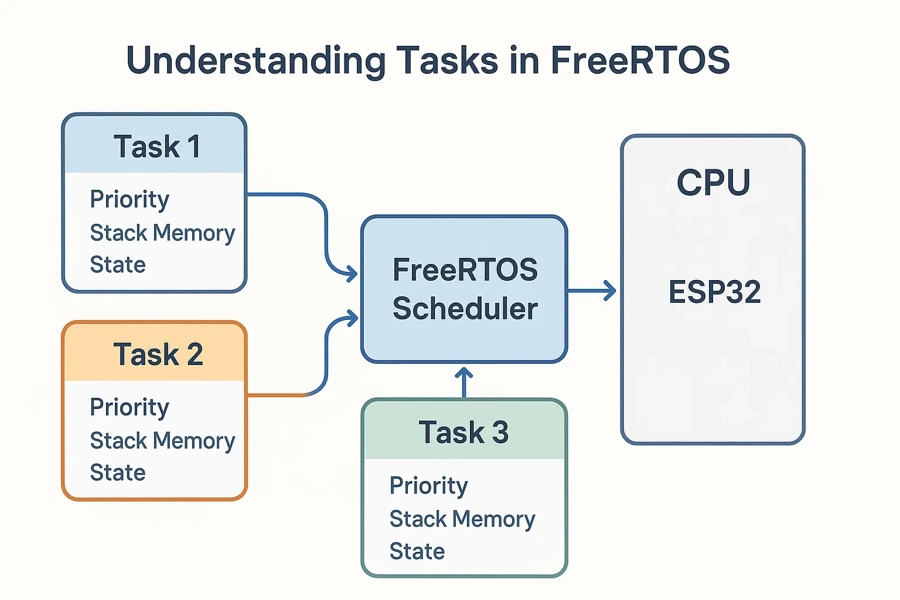 -
- 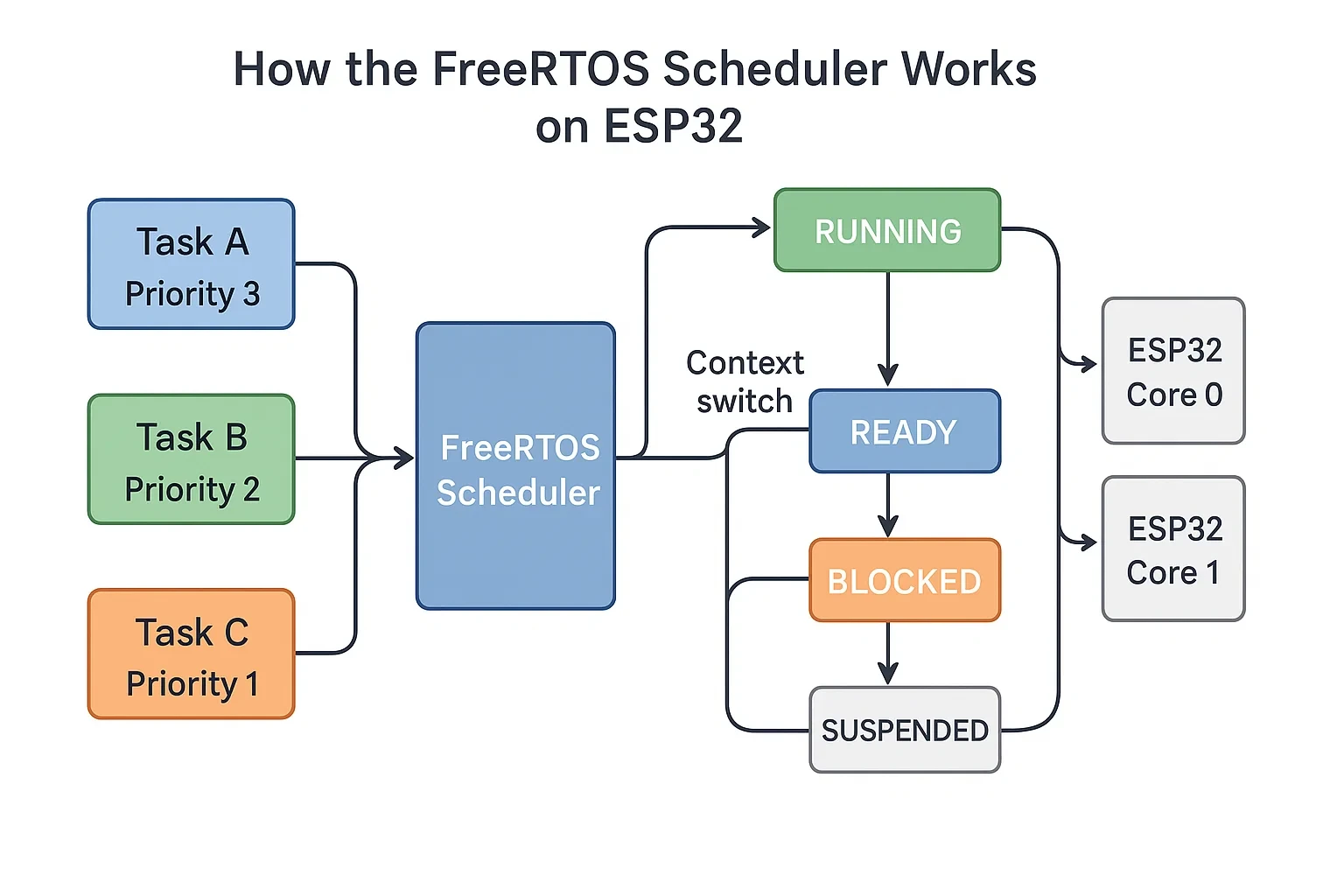 -
- 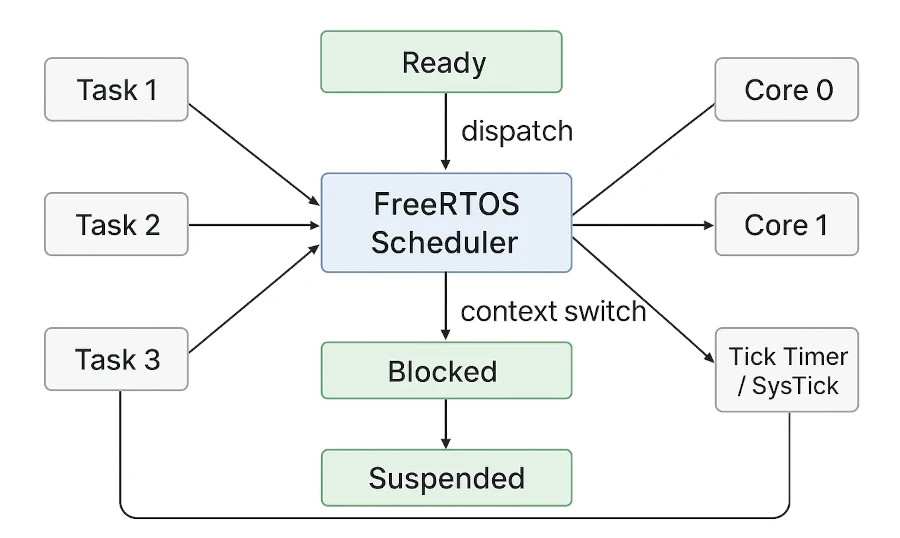 -
- 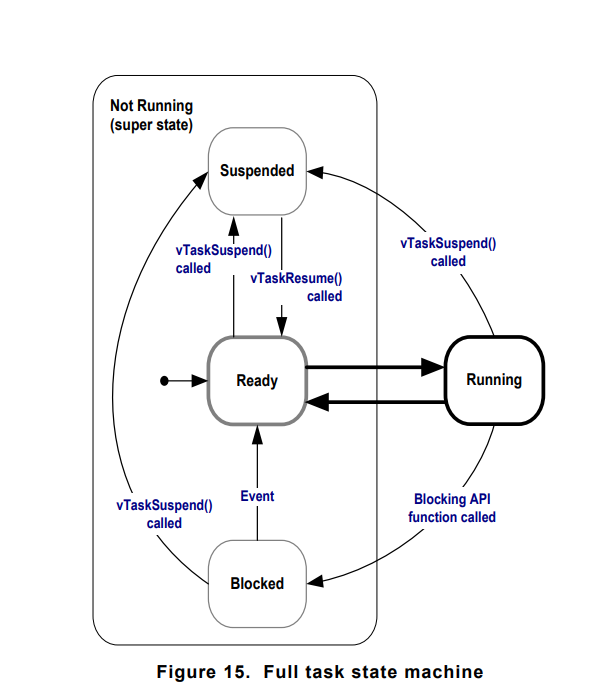 -
- [freeRTOS univertisty wisconsin](https://ece353.engr.wisc.edu/freertos/queues/)
- Double buffer instead of circular Buffer
-
-
- [freeRTOS univertisty wisconsin](https://ece353.engr.wisc.edu/freertos/queues/)
- Double buffer instead of circular Buffer
- 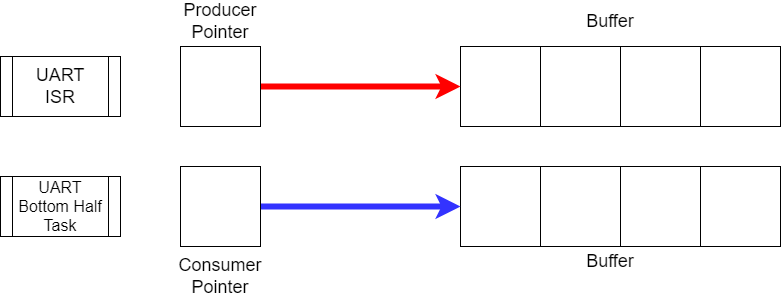 -
- 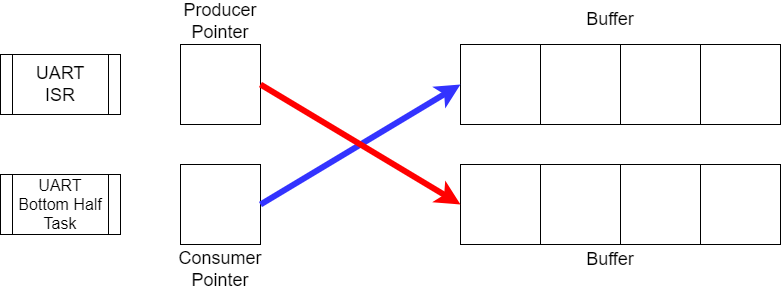 -
- 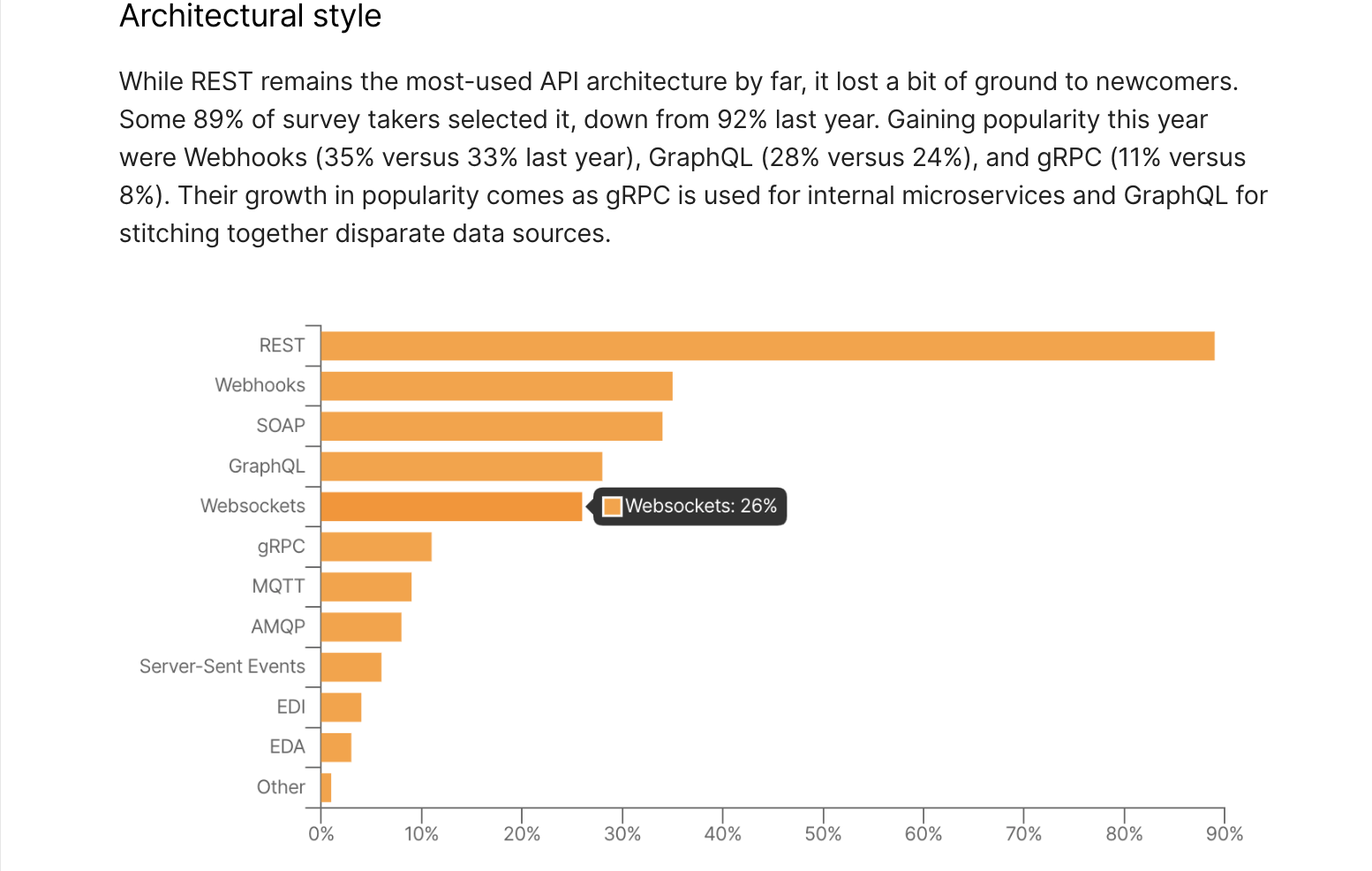 - Memory allocation in freertos
When FreeRTOS requires RAM it calls pvPortMalloc() instead of malloc(). Likewise, when FreeRTOS frees previously allocated RAM it calls vPortFree() instead of free().
pvPortMalloc() has the same prototype as the standard C library malloc() function, and vPortFree() has the same prototype as the standard C library free() function.
pvPortMalloc() and vPortFree() are public functions, so can also be called from application code.
FreeRTOS comes with five example implementations of pvPortMalloc() and vPortFree(), which
# [Step 4: Build and Flash the Project](https://www.oceanlabz.in/dynamic-memory-allocation-in-freertos/?srsltid=AfmBOortTOiF-1ePjg2wiFSQ2I-NKGJgnLPjlcBVZCTqRGQMaCMCrjhi)
- . :/media/edy/LocakDsk/Arduino/esp-idf/export.sh
- idf.py build
- idf.py -p /dev/ttyACM0 flash
- idf.py monitor
# waiting for interrupt
void vApplicationIdleHook( void )
{
asm volatile (" WFI \n" );
}
# [Micropythn esp32c6](https://micropython.org/download/ESP32_GENERIC_C6/)
- cargo install espup
- [spotpear](https://spotpear.com/wiki/ESP32-C6-LCD-1.47-inch-LCD-Display-TouchScreen-LVGL-SD-AXS5106L-JD9853.html)
# [Three phase PWM](https://blog.embeddedexpert.io/?p=3920)
# [1 wire protocol using 9600bps?](https://blog.embeddedexpert.io/?p=3896)
- [more detail](https://blog.embeddedexpert.io/?p=3858)
- use software instead of hardware for daata write and read (master slave configuration)
|Material |p (RESISIVITY) IN OHM-CM|
|---------|------------------------|
|Aluminium| 2.82 × 10⁻⁶|
|Copper | 1.68 × 10%6|
|Gold |2.44 × 10⁻⁶|
|Iron |1.00 x 10⁻⁵|
|Silver |1.59 × 10⁻⁶|
# Vn Dorn Bottle ( collect water sample with depth)
# salinity refractometer
a salinity refractometer is generally more accurate than a conductivity-based salinity probe for measuring salinity in aqueous solutions, particularly in marine and aquarium applications. Here’s why:
1. Principle of Measurement
Refractometer: Measures salinity based on the refractive index of water, which changes with dissolved salts. This method directly correlates with the actual salt content.
Conductivity Probe: Measures salinity indirectly by detecting electrical conductivity, which depends on ion concentration. However, conductivity can be affected by factors other than salinity (e.g., temperature, dissolved organics, or other ions).
2. Accuracy & Precision
Refractometers provide higher precision (±0.1–0.2 ppt) for salinity measurements in seawater and brines.
Conductivity probes can be less precise (±1–2 ppt or more) unless calibrated frequently and compensated for temperature.
3. Common Interferences
Refractometer: Mostly unaffected by non-salt impurities (e.g., organics, gases) unless they significantly alter refractive index.
Conductivity Probe: Affected by temperature fluctuations, contaminants (e.g., ammonia, CO₂), and non-salt ions, leading to potential inaccuracies.
4. Calibration & Maintenance
Refractometers require simple calibration with distilled water or a known standard.
Conductivity probes need regular calibration (often with standard solutions) and temperature compensation for accurate readings.
When to Use Each?
Use a refractometer for:
Marine aquariums (reef tanks, saltwater systems)
Brine solutions (food processing, hydroponics)
High-precision salinity checks
Use a conductivity probe for:
Continuous monitoring (e.g., aquaculture, industrial processes)
Situations where rapid, automated readings are needed
Conclusion
For absolute salinity accuracy, a refractometer is superior. However, conductivity probes are useful for real-time monitoring where slight variations are acceptable. For critical applications (e.g., coral reef tanks), a refractometer is the gold standard.
Final Tips for Best Results
✅ For refractometers:
Store in a protective case (prevents scratches).
Avoid direct sunlight (can warp the prism).
✅ For conductivity probes:
Use storage solution (like KCl) to prolong lifespan.
Replace every 1–2 years for consistent accuracy.
# Prevent Fouling for conductivity probe
- Memory allocation in freertos
When FreeRTOS requires RAM it calls pvPortMalloc() instead of malloc(). Likewise, when FreeRTOS frees previously allocated RAM it calls vPortFree() instead of free().
pvPortMalloc() has the same prototype as the standard C library malloc() function, and vPortFree() has the same prototype as the standard C library free() function.
pvPortMalloc() and vPortFree() are public functions, so can also be called from application code.
FreeRTOS comes with five example implementations of pvPortMalloc() and vPortFree(), which
# [Step 4: Build and Flash the Project](https://www.oceanlabz.in/dynamic-memory-allocation-in-freertos/?srsltid=AfmBOortTOiF-1ePjg2wiFSQ2I-NKGJgnLPjlcBVZCTqRGQMaCMCrjhi)
- . :/media/edy/LocakDsk/Arduino/esp-idf/export.sh
- idf.py build
- idf.py -p /dev/ttyACM0 flash
- idf.py monitor
# waiting for interrupt
void vApplicationIdleHook( void )
{
asm volatile (" WFI \n" );
}
# [Micropythn esp32c6](https://micropython.org/download/ESP32_GENERIC_C6/)
- cargo install espup
- [spotpear](https://spotpear.com/wiki/ESP32-C6-LCD-1.47-inch-LCD-Display-TouchScreen-LVGL-SD-AXS5106L-JD9853.html)
# [Three phase PWM](https://blog.embeddedexpert.io/?p=3920)
# [1 wire protocol using 9600bps?](https://blog.embeddedexpert.io/?p=3896)
- [more detail](https://blog.embeddedexpert.io/?p=3858)
- use software instead of hardware for daata write and read (master slave configuration)
|Material |p (RESISIVITY) IN OHM-CM|
|---------|------------------------|
|Aluminium| 2.82 × 10⁻⁶|
|Copper | 1.68 × 10%6|
|Gold |2.44 × 10⁻⁶|
|Iron |1.00 x 10⁻⁵|
|Silver |1.59 × 10⁻⁶|
# Vn Dorn Bottle ( collect water sample with depth)
# salinity refractometer
a salinity refractometer is generally more accurate than a conductivity-based salinity probe for measuring salinity in aqueous solutions, particularly in marine and aquarium applications. Here’s why:
1. Principle of Measurement
Refractometer: Measures salinity based on the refractive index of water, which changes with dissolved salts. This method directly correlates with the actual salt content.
Conductivity Probe: Measures salinity indirectly by detecting electrical conductivity, which depends on ion concentration. However, conductivity can be affected by factors other than salinity (e.g., temperature, dissolved organics, or other ions).
2. Accuracy & Precision
Refractometers provide higher precision (±0.1–0.2 ppt) for salinity measurements in seawater and brines.
Conductivity probes can be less precise (±1–2 ppt or more) unless calibrated frequently and compensated for temperature.
3. Common Interferences
Refractometer: Mostly unaffected by non-salt impurities (e.g., organics, gases) unless they significantly alter refractive index.
Conductivity Probe: Affected by temperature fluctuations, contaminants (e.g., ammonia, CO₂), and non-salt ions, leading to potential inaccuracies.
4. Calibration & Maintenance
Refractometers require simple calibration with distilled water or a known standard.
Conductivity probes need regular calibration (often with standard solutions) and temperature compensation for accurate readings.
When to Use Each?
Use a refractometer for:
Marine aquariums (reef tanks, saltwater systems)
Brine solutions (food processing, hydroponics)
High-precision salinity checks
Use a conductivity probe for:
Continuous monitoring (e.g., aquaculture, industrial processes)
Situations where rapid, automated readings are needed
Conclusion
For absolute salinity accuracy, a refractometer is superior. However, conductivity probes are useful for real-time monitoring where slight variations are acceptable. For critical applications (e.g., coral reef tanks), a refractometer is the gold standard.
Final Tips for Best Results
✅ For refractometers:
Store in a protective case (prevents scratches).
Avoid direct sunlight (can warp the prism).
✅ For conductivity probes:
Use storage solution (like KCl) to prolong lifespan.
Replace every 1–2 years for consistent accuracy.
# Prevent Fouling for conductivity probe


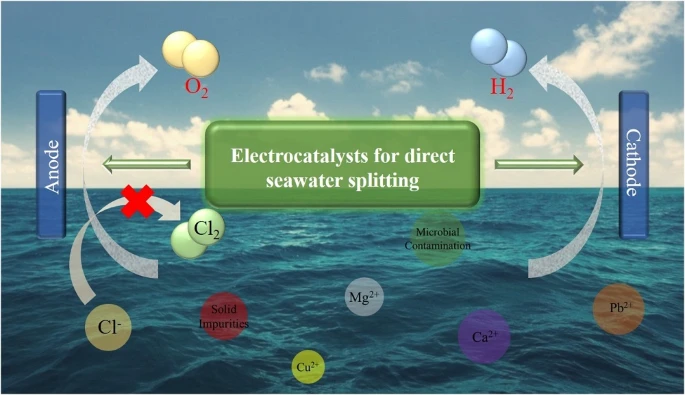

 a salinometer based on the electrical conductivity of seawater, together with temperature, provides salinity (S) readings.
To be more specific, S is calculated from the ratio of the conductivity of seawater to that of a KCl solution (32.4356 g/kg), with both measurements made at 15 °C
and under one-atmosphere pressure [7,35,36,37]. It can then be converted to chlorinity using the Knudsen equation (Equation (1)) [6].
S (g Kg−1)=1.80665 Cl (g Kg−1)
- [seawater calculation on TEOS-10](https://monrecifamoi.saulme.fr/salinite/sea_water_calculator_teos10.php)
- [salinity on PS-788 formula](https://salinometry.com/pss-78/)
# [Temperature T90](https://www.fluke.com/en-us/learn/blog/calibration/its-90?srsltid=AfmBOoohzT0IVs5LWmdxRaTlXLjq-iJ-acMKxxWhLNSr8dyFQ98EE7rf)
# install uv in windows
winget install --id=astral-sh.uv -e
uv self update
uv python install 3.14
uv add flask
uv run -- flask run -p 3000
Create a project.
uv init project
Move into the project directory.
cd project
Add ipykernel as a dev dependency.
uv add --dev ipykernel
Open the project in VS Code.
code .
8. Case Study: OpenCTD Anti-Fouling
The open-source OpenCTD uses:
Teflon-coated electrodes.
Pulsed AC measurement (no DC bias).
Manual cleaning during calibration.
. Effectiveness Comparison
|Method| Biofilm Prevention| Mineral Fouling |Cost| Complexity|
|------|--------------------|-----------------|----|-------------|
|Silicone Coatings| Medium |Low |$| Low|
|Mechanical Wipers| High| High| $$$ |High|
|Pulsed Polarization| Medium| Medium| $$| Medium|
|UV-C LEDs| High| Low| $$ |Medium|
[Howland current pump using voltage opamp](https://neurophysics.ucsd.edu/courses/physics_171/The%20Howland%20Current%20Pump.pdf)
[show constant current](https://circuitcellar.com/resources/quickbits/howland-current-source/)
[Design guide](https://www.how2power.com/search/index.php)
[Image Maker](https://imageresizer.com/)
[pdfum binary](https://github.com/bblanchon/pdfium-binaries)
# [Fisherman boat](https://explorer.com.my/product/e190-floorboard/)
## Perahu fiber lebih dangkal karena ringgang untuk pulau yang berkarang karena karang bisa membuat perahu itu pecah/rusak
- fiber perahu ika dari malaysia (40HP=40PK- 54juta)-need 15PK (15PK=32 juta)
- Bor air : 12 m air laut, 30m air tawar
- di palemenbang 120m dapat air minum
- kaporit terlalu tinggi di danau di atas petong
- cumi yang di es berwarna merah keesokan harinya
- 1 knot =1.852km/hours
- [fisherman boats](https://jixingxincomposite.en.made-in-china.com/product/NJpUiKoPaQYS/China-New-Design-High-Quality-Motor-Boat-Boat-Fishing-Fiberglass-Boat.html)
- inyak 40pk motor (oil consumption 20L/hours)
- Water coloumn
- air laut bataam diambil dari kedalaman 12m, di Norwegia diambil dari kedalamaan 75m dari permukaan laut
- fiber boat puny hendra pulaupetong:
-17" dan 21" (5.5 m ~ 7 m) , boat: 27 juta
- mesin yamaha 15HP ( 2x)
- supaya temperature nya hampir sama dengan culture temperature
- Pulau Benan: Judit, Petong Hendra
- pH nya konstant di kedalaman ?
- [cuaca dan agin di pulau petong](https://www.windy.com/0.629/104.082?0.626,104.094,15)
- 65% kapal nelayan adalaah terbuat dari kayu (10`15 year)
- Mesin bukan dmeesia kapal akibatnya mudah terjadi korosi
-[converting carebouretor with fuel injection](https://jlmmarine.com/blogs/outboard-101/converting-your-outboard-from-carburetor-to-efi-is-it-worth-it?srsltid=AfmBOoq6V8xbNVkF61U0qFeOkS_v15pkyRu-QDQ-liBLQYTKIk9GGrd7)
- mixture air and fuel (caarburetor with fuel injection)
- [two stroke petrol engine 2-Stroke Mixture](https://penriteoil.com.au/assets/tech_pdfs/1202%20-%20Technical%20Bulletin%20Two%20Stroke%20Engine%20Oils.pdf):
a salinometer based on the electrical conductivity of seawater, together with temperature, provides salinity (S) readings.
To be more specific, S is calculated from the ratio of the conductivity of seawater to that of a KCl solution (32.4356 g/kg), with both measurements made at 15 °C
and under one-atmosphere pressure [7,35,36,37]. It can then be converted to chlorinity using the Knudsen equation (Equation (1)) [6].
S (g Kg−1)=1.80665 Cl (g Kg−1)
- [seawater calculation on TEOS-10](https://monrecifamoi.saulme.fr/salinite/sea_water_calculator_teos10.php)
- [salinity on PS-788 formula](https://salinometry.com/pss-78/)
# [Temperature T90](https://www.fluke.com/en-us/learn/blog/calibration/its-90?srsltid=AfmBOoohzT0IVs5LWmdxRaTlXLjq-iJ-acMKxxWhLNSr8dyFQ98EE7rf)
# install uv in windows
winget install --id=astral-sh.uv -e
uv self update
uv python install 3.14
uv add flask
uv run -- flask run -p 3000
Create a project.
uv init project
Move into the project directory.
cd project
Add ipykernel as a dev dependency.
uv add --dev ipykernel
Open the project in VS Code.
code .
8. Case Study: OpenCTD Anti-Fouling
The open-source OpenCTD uses:
Teflon-coated electrodes.
Pulsed AC measurement (no DC bias).
Manual cleaning during calibration.
. Effectiveness Comparison
|Method| Biofilm Prevention| Mineral Fouling |Cost| Complexity|
|------|--------------------|-----------------|----|-------------|
|Silicone Coatings| Medium |Low |$| Low|
|Mechanical Wipers| High| High| $$$ |High|
|Pulsed Polarization| Medium| Medium| $$| Medium|
|UV-C LEDs| High| Low| $$ |Medium|
[Howland current pump using voltage opamp](https://neurophysics.ucsd.edu/courses/physics_171/The%20Howland%20Current%20Pump.pdf)
[show constant current](https://circuitcellar.com/resources/quickbits/howland-current-source/)
[Design guide](https://www.how2power.com/search/index.php)
[Image Maker](https://imageresizer.com/)
[pdfum binary](https://github.com/bblanchon/pdfium-binaries)
# [Fisherman boat](https://explorer.com.my/product/e190-floorboard/)
## Perahu fiber lebih dangkal karena ringgang untuk pulau yang berkarang karena karang bisa membuat perahu itu pecah/rusak
- fiber perahu ika dari malaysia (40HP=40PK- 54juta)-need 15PK (15PK=32 juta)
- Bor air : 12 m air laut, 30m air tawar
- di palemenbang 120m dapat air minum
- kaporit terlalu tinggi di danau di atas petong
- cumi yang di es berwarna merah keesokan harinya
- 1 knot =1.852km/hours
- [fisherman boats](https://jixingxincomposite.en.made-in-china.com/product/NJpUiKoPaQYS/China-New-Design-High-Quality-Motor-Boat-Boat-Fishing-Fiberglass-Boat.html)
- inyak 40pk motor (oil consumption 20L/hours)
- Water coloumn
- air laut bataam diambil dari kedalaman 12m, di Norwegia diambil dari kedalamaan 75m dari permukaan laut
- fiber boat puny hendra pulaupetong:
-17" dan 21" (5.5 m ~ 7 m) , boat: 27 juta
- mesin yamaha 15HP ( 2x)
- supaya temperature nya hampir sama dengan culture temperature
- Pulau Benan: Judit, Petong Hendra
- pH nya konstant di kedalaman ?
- [cuaca dan agin di pulau petong](https://www.windy.com/0.629/104.082?0.626,104.094,15)
- 65% kapal nelayan adalaah terbuat dari kayu (10`15 year)
- Mesin bukan dmeesia kapal akibatnya mudah terjadi korosi
-[converting carebouretor with fuel injection](https://jlmmarine.com/blogs/outboard-101/converting-your-outboard-from-carburetor-to-efi-is-it-worth-it?srsltid=AfmBOoq6V8xbNVkF61U0qFeOkS_v15pkyRu-QDQ-liBLQYTKIk9GGrd7)
- mixture air and fuel (caarburetor with fuel injection)
- [two stroke petrol engine 2-Stroke Mixture](https://penriteoil.com.au/assets/tech_pdfs/1202%20-%20Technical%20Bulletin%20Two%20Stroke%20Engine%20Oils.pdf):
 "
|Fuel / Oil Ratio | mls per 1 Litreof fuel|mls per 5 Litres of fuel|mls per 10 Litres of fuel| mls per 20 Litres of fuel|
|-----------------|-----------------------|------------------------|--------------------------|-------------------------|
|5:1 |200 |1000| 2000 |4000|
|10:1 |100 |500 |1000 |2000|
|15:1 |67 |333 |667| 1333|
|16:1 |63 |313 |625 |1250|
|20:1 |50 |250 |500 |1000|
|25:1 | 40 |200|400|800|
|30:1 | 33 |167|333|667|
|33:1 | 30 |152|303|606|
|35:1 | 29 |143|286|571|
|40:1 | 25 |125|250|500|
|45:1 | 22 |111|222|444|
|50:1| 20| 100 |200 |400|
|55:1 |18 |91|182|364|
|60:1 |17 |83|167|333|
|65:1 |15 |77|154|308|
|70:1 |14 |72|143|286|
|75:1 |13 |67|133|267|
|80:1 |13 |63|125|250|
|85:1 |12 |60|120|240|
|90:1 |11 |55|110|220|
|95:1 |11 |53|105|210|
|100:1 |10| 50 |100 |200|
Common Ratios:
50:1 (Most Modern Equipment): 1 gallon of gas to 2.6 ounces of oil, or 5 liters of gas to 100ml of oil.
40:1 (General/Older Equipment): 1 gallon of gas to 3.2 ounces of oil, or 5 liters of gas to 125ml of oil.
32:1 (Older/High-Performance): 1 gallon of gas to 4.6 ounces of oil.
* [Clasification River class boat](https://itayachtscanada.com/understand-the-class-a-b-c-d-in-yachting/)
* [First aid in the boat](https://www.ecfr.gov/current/title-46/chapter-I/subchapter-W/part-199/subpart-B/section-199.175)
# Boat engine
- Yamaha, Suzuki, Honda
- Yamabisi (9.9 HP, 7.3kW) - speed 10km/hour
- fuel pump
- 92 octane
- 4 stroke
- Mercury
- China outboard engines (gasoline?, electric):
- Parsun
-
- shallow water
- need long tail engine
## Two engine on the back
- mounting on the opposite direction for engine one and engine two . ( only the fance of the engine ?)
- higher drag for 2 engine
- Engine running at 1000rmpm, 3000rmp (fuel economy), 4000rmpm, 5000rpm and 5800 rpm (max)
- Smaller engine can be all electric
- Hangkian marine egine (electric)
## [Hull speed](https://www.marineinsight.com/marine-navigation/understanding-vessels-hull-speed-and-its-determination/)
- it is posible to incrase boat speed to > hull speed with various method
## [Longtail boat Thailand](https://snorkelingthailand.com/thai-longtail-boat/)
[longtail 2](https://www.mdpi.com/2032-6653/12/1/36)
## Buble help ship save fuel
[Hull calculator](https://www.omnicalculator.com/sports/hull-speed)
|Water line length
"
|Fuel / Oil Ratio | mls per 1 Litreof fuel|mls per 5 Litres of fuel|mls per 10 Litres of fuel| mls per 20 Litres of fuel|
|-----------------|-----------------------|------------------------|--------------------------|-------------------------|
|5:1 |200 |1000| 2000 |4000|
|10:1 |100 |500 |1000 |2000|
|15:1 |67 |333 |667| 1333|
|16:1 |63 |313 |625 |1250|
|20:1 |50 |250 |500 |1000|
|25:1 | 40 |200|400|800|
|30:1 | 33 |167|333|667|
|33:1 | 30 |152|303|606|
|35:1 | 29 |143|286|571|
|40:1 | 25 |125|250|500|
|45:1 | 22 |111|222|444|
|50:1| 20| 100 |200 |400|
|55:1 |18 |91|182|364|
|60:1 |17 |83|167|333|
|65:1 |15 |77|154|308|
|70:1 |14 |72|143|286|
|75:1 |13 |67|133|267|
|80:1 |13 |63|125|250|
|85:1 |12 |60|120|240|
|90:1 |11 |55|110|220|
|95:1 |11 |53|105|210|
|100:1 |10| 50 |100 |200|
Common Ratios:
50:1 (Most Modern Equipment): 1 gallon of gas to 2.6 ounces of oil, or 5 liters of gas to 100ml of oil.
40:1 (General/Older Equipment): 1 gallon of gas to 3.2 ounces of oil, or 5 liters of gas to 125ml of oil.
32:1 (Older/High-Performance): 1 gallon of gas to 4.6 ounces of oil.
* [Clasification River class boat](https://itayachtscanada.com/understand-the-class-a-b-c-d-in-yachting/)
* [First aid in the boat](https://www.ecfr.gov/current/title-46/chapter-I/subchapter-W/part-199/subpart-B/section-199.175)
# Boat engine
- Yamaha, Suzuki, Honda
- Yamabisi (9.9 HP, 7.3kW) - speed 10km/hour
- fuel pump
- 92 octane
- 4 stroke
- Mercury
- China outboard engines (gasoline?, electric):
- Parsun
-
- shallow water
- need long tail engine
## Two engine on the back
- mounting on the opposite direction for engine one and engine two . ( only the fance of the engine ?)
- higher drag for 2 engine
- Engine running at 1000rmpm, 3000rmp (fuel economy), 4000rmpm, 5000rpm and 5800 rpm (max)
- Smaller engine can be all electric
- Hangkian marine egine (electric)
## [Hull speed](https://www.marineinsight.com/marine-navigation/understanding-vessels-hull-speed-and-its-determination/)
- it is posible to incrase boat speed to > hull speed with various method
## [Longtail boat Thailand](https://snorkelingthailand.com/thai-longtail-boat/)
[longtail 2](https://www.mdpi.com/2032-6653/12/1/36)
## Buble help ship save fuel
[Hull calculator](https://www.omnicalculator.com/sports/hull-speed)
|Water line length in feet |Hull speed
in knots| Hull speed
in mph |Hull speed
in km/h| |--------------------------|-------------------|--------------------|-----------------| |8 ft (2.438m) |3.8 kn |4.4 mph |7.0 km/h | |9 (2.74m) |4.0 |4.7 |7.4 | |10 (3.048m) |4.3 |4.9 |8.0 | |11 |4.5 |5.2 |8.3 | |12 |4.7 |5.4 |8.7 | |13 |4.9 |5.6 |9.1 | |14|5.0|5.8|9.3| |15 (4.57m)|5.2|6.0|9.6| |16|5.4|6.2|10.0| |17|5.6|6.4|10.3| |18|5.7|6.6|10.5| |19|5.9|6.8|10.9| |20|6.0 |6.9 |11.1| |21|6.2|7.1|11.5| |22|6.3|7.3|11.7| |23|6.5|7.5|12.0| |24|6.6|7.6|12.2| |25|6.7|7.8|12.4| |26|6.9|7.9|12.8| |27|7.0|8.1|13.0| |28|7.1|8.2|13.2| |29|7.3|8.4|13.5| |30|7.4|8.5|13.7| |31|7.5|8.6|13.9| --- [speed vs power consumption for boat with centain length](https://marinaut.nl/en/pages/berekening-elektrisch-varen) * boats up to 7 meters you can sail a day at 7 kilometers per hour with only 3 kW of engine power and 4 kWh battery power (30km) Electric motor sailing speed Do you have a planing boat (that can 'skim' the water instead of just through it)? Then you can go faster than the hull speed. Otherwise, the maximum speed is the hull speed . You calculate the hull speed by multiplying the square root of the waterline of the ship in meters by 4.5. Waterline = the part of the boat length that touches the water. If you don't know the water length, take the length of the boat and subtract half a meter for convenience. So at a waterline of: 8 meters you reach 13 kilometers per hour; 7 meters you reach 12 kilometers per hour; 6 meters you reach 11 kilometers per hour; 5 meters you reach 10 kilometers per hour; 4 meters you reach 9 kilometers per hour; 3 meters you reach 8 kilometers per hour. Cruising speed is the economic speed at which a boat can move as efficiently as possible. This speed is always a trade-off between speed and fuel consumption. The economic speed is 70% of the hull speed, so at: 8 meters = 9 kilometers per hour; 7 meters = 8 kilometers per hour; 6 meters = 8 kilometers per hour; 5 meters = 7 kilometers per hour; 4 meters = 6 kilometers per hour; 3 meters = 6 kilometers per hour. They manufacture electric outboards, inboards and saildrives as well as accessories and Lithium-ion batteries using a Carbon Nano Tube heat exchanger technology [16km/hour 6KWh](https://marinaut.nl/products/epropulsion-navy-6-0-evo-6kw-elektrische-buitenboordmotor?variant=50995199410516) [engine speed and weight](https://vetusonline.se/swedish/engine-power_requirement_calculator) - Formula: Power (HP) = (Displacement (tons) ^ (2/3) × Speed³) / Hull Factor - Hull factors: 45 (displacement), 70 (semi-displacement), 100 (planing). [Apollo machine](https://www.apollo.com.sg/) need long shaft fiber (thickness) |category | 2-Stroke-15HP |4-Stroke-HP| |----|----------|--------| |weight| 34kg | 70+kg | |fuel | gasoline+ oily mixture| pure Gasoline| |consumption| burn a lot of Oil+gas| 40% less consumption| Material: Marine Grade Aluminum DNV 5083✔️ ---
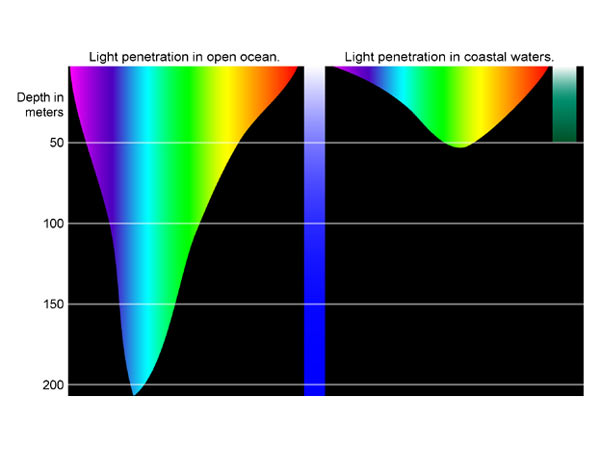
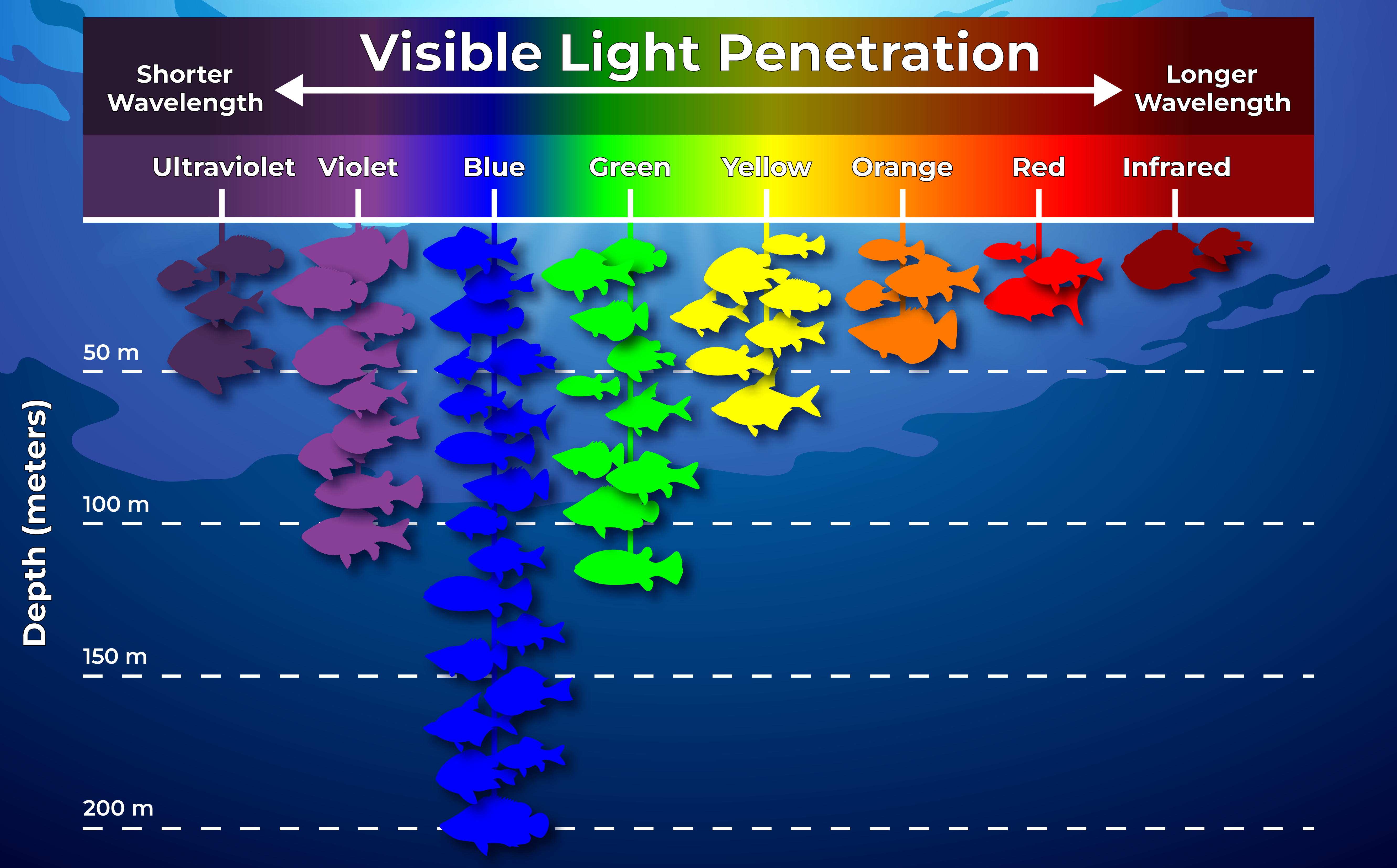 A 1.7m visibility level indicates a reasonable light environment for photosynthesis, provided the water is not filled with sediments that block
light absorption. If the 1.7m visibility is caused by high phytoplankton levels, it indicates that nutrients are available in the water
[xxx](https://www.frontiersin.org/journals/marine-science/articles/10.3389/fmars.2015.00026/full)
---
# [Marine electrical outboard Battery](https://plugboats.com/plugboats-guide-to-electric-boat-batteries/)
1. LiNiMnCoCO2
2. LiFePO4, [blade LiFFePO4](https://youtu.be/x-eTg93-zZo?si=LESKaxFSOwH260W1)
- liquid
- solid state
- Dry
3. acid
## Charging
- Level 1 (house hold)
- Level 2 (Fast charging)
[image banner test](https://www.adspeed.com/Ad-Gallery/Image-Banner-Multiple-Clickable-Buttons-2016.html)
A 1.7m visibility level indicates a reasonable light environment for photosynthesis, provided the water is not filled with sediments that block
light absorption. If the 1.7m visibility is caused by high phytoplankton levels, it indicates that nutrients are available in the water
[xxx](https://www.frontiersin.org/journals/marine-science/articles/10.3389/fmars.2015.00026/full)
---
# [Marine electrical outboard Battery](https://plugboats.com/plugboats-guide-to-electric-boat-batteries/)
1. LiNiMnCoCO2
2. LiFePO4, [blade LiFFePO4](https://youtu.be/x-eTg93-zZo?si=LESKaxFSOwH260W1)
- liquid
- solid state
- Dry
3. acid
## Charging
- Level 1 (house hold)
- Level 2 (Fast charging)
[image banner test](https://www.adspeed.com/Ad-Gallery/Image-Banner-Multiple-Clickable-Buttons-2016.html)
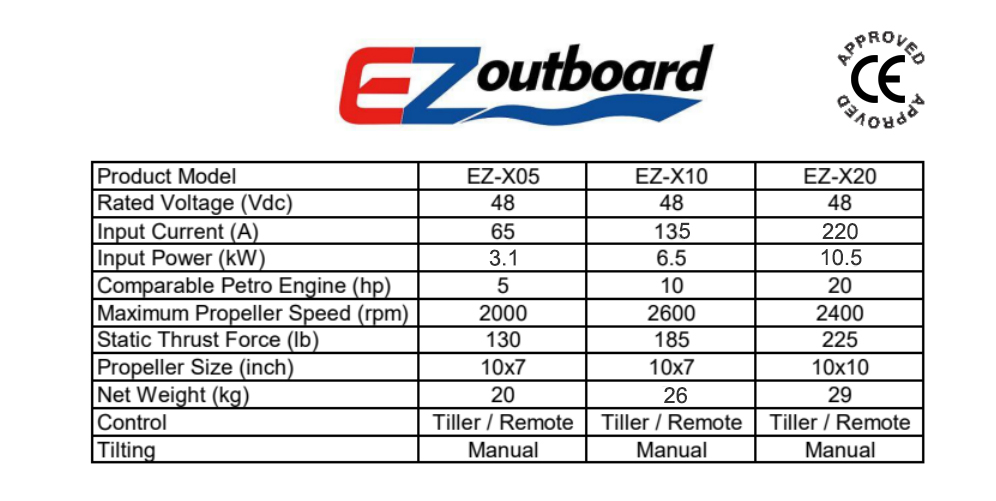 [graphene](https://youtu.be/QUfJu3wLjxI?si=gaWSLz7gqFoA355F)
# [Inboard vs outboard](https://goldenmotor.com//?utm_source=plugboats&utm_campaign=chat)
[fiberglass boat vs alluminium alloy](https://www.discoverboating.com/resources/aluminum-vs-fiberglass-boats)
- Unleashing Power: High Torque Axial Flux Drivetrains
- Good for High Thrust Direct Drive Applications without Gearbox
[epropulsion](https://www.epropulsion.com/parts-database/e100-battery)
[graphene](https://youtu.be/QUfJu3wLjxI?si=gaWSLz7gqFoA355F)
# [Inboard vs outboard](https://goldenmotor.com//?utm_source=plugboats&utm_campaign=chat)
[fiberglass boat vs alluminium alloy](https://www.discoverboating.com/resources/aluminum-vs-fiberglass-boats)
- Unleashing Power: High Torque Axial Flux Drivetrains
- Good for High Thrust Direct Drive Applications without Gearbox
[epropulsion](https://www.epropulsion.com/parts-database/e100-battery)

 https://dexmarine.com/special-offers/
# [NEMA2000](https://www.nmea.org/nmea-2000.html)
[vectron compatible](https://www.victronenergy.com/live/ve.can:nmea-2000:start)
[micropython display](https://developer.quectel.com/doc/quecpython/Application_guide/en/system/info.html)
[QuecMicropython](https://github.com/QuecPython/solution-Agriculture-Control-Panel)
[eventmesh](https://python.quectel.com/doc/quecpython/Application_guide/en/system/thread.html)
[solace eventmesh](https://solace.com/blog/pubsub-plus-messaging-api-for-python/)
What is an event mesh?
An [event mesh is an architecture layer](https://github.com/SolaceLabs/solace-agent-mesh) that allows events from one application to be dynamically routed and received by any other application
no matter where these applications are deployed (no cloud, private cloud, public cloud). This layer is composed by a network of Event Brokers.
Event brokers are a modern form of messaging middleware, which are designed to move events across the distributed enterprise.
Need a simple, practical intro to NMEA 2000?
In this guide we introduce the N2K protocol (IEC 61162-3) used in maritime vessels such as boats, yachts, tugs and other ships. In particular,
we'll cover the NMEA 2000 standards, key concepts, links to other protocols (NMEA 0183, CAN/J1939), topology and connectors.
We also cover NMEA 2000 PGNs and Fast Packets.
NMEA 2000 (IEC 61162-3) is a communication standard used in the maritime industry for connecting e.g. engines,
instruments and sensors on boats. It is based on the Controller Area Network (CAN) and allows data to be sent/received between
devices over a single network 'backbone' cable.
The higher layer functionality of NMEA 2000 (aka N2K) is based on SAE J1939 and ISOBUS (ISO 11783), commonly used in heavy-duty vehicles
and agriculture/forestry machinery, respectively
[Power engineering](https://www.purepower.com/blogs/aluminum-conductors-in-solar-applications-how-to-save-costs-without-sacrificing-reliability)
[copper alloy prevent biofoling](https://www.mitsubishi-copper.com/en/assets/pdf/UR30ST_EN_202004.pdf)
[wire mesh for aquaculture](https://temisamexico.com/en/products-wire-mesh.html)
[aquaculure Netting](https://www.walcoom.com/pdf/aquaculture-netting.pdf)
[wovenwire mesh](https://dwt-inc.com/wp-content/docs/woven-wire-cloth.pdf)
[BMS design controller](https://www.victronenergy.com/media/pg/Lithium_Battery_Smart/en/system-design-and-bms-selection-guide.html)
https://dexmarine.com/special-offers/
# [NEMA2000](https://www.nmea.org/nmea-2000.html)
[vectron compatible](https://www.victronenergy.com/live/ve.can:nmea-2000:start)
[micropython display](https://developer.quectel.com/doc/quecpython/Application_guide/en/system/info.html)
[QuecMicropython](https://github.com/QuecPython/solution-Agriculture-Control-Panel)
[eventmesh](https://python.quectel.com/doc/quecpython/Application_guide/en/system/thread.html)
[solace eventmesh](https://solace.com/blog/pubsub-plus-messaging-api-for-python/)
What is an event mesh?
An [event mesh is an architecture layer](https://github.com/SolaceLabs/solace-agent-mesh) that allows events from one application to be dynamically routed and received by any other application
no matter where these applications are deployed (no cloud, private cloud, public cloud). This layer is composed by a network of Event Brokers.
Event brokers are a modern form of messaging middleware, which are designed to move events across the distributed enterprise.
Need a simple, practical intro to NMEA 2000?
In this guide we introduce the N2K protocol (IEC 61162-3) used in maritime vessels such as boats, yachts, tugs and other ships. In particular,
we'll cover the NMEA 2000 standards, key concepts, links to other protocols (NMEA 0183, CAN/J1939), topology and connectors.
We also cover NMEA 2000 PGNs and Fast Packets.
NMEA 2000 (IEC 61162-3) is a communication standard used in the maritime industry for connecting e.g. engines,
instruments and sensors on boats. It is based on the Controller Area Network (CAN) and allows data to be sent/received between
devices over a single network 'backbone' cable.
The higher layer functionality of NMEA 2000 (aka N2K) is based on SAE J1939 and ISOBUS (ISO 11783), commonly used in heavy-duty vehicles
and agriculture/forestry machinery, respectively
[Power engineering](https://www.purepower.com/blogs/aluminum-conductors-in-solar-applications-how-to-save-costs-without-sacrificing-reliability)
[copper alloy prevent biofoling](https://www.mitsubishi-copper.com/en/assets/pdf/UR30ST_EN_202004.pdf)
[wire mesh for aquaculture](https://temisamexico.com/en/products-wire-mesh.html)
[aquaculure Netting](https://www.walcoom.com/pdf/aquaculture-netting.pdf)
[wovenwire mesh](https://dwt-inc.com/wp-content/docs/woven-wire-cloth.pdf)
[BMS design controller](https://www.victronenergy.com/media/pg/Lithium_Battery_Smart/en/system-design-and-bms-selection-guide.html)

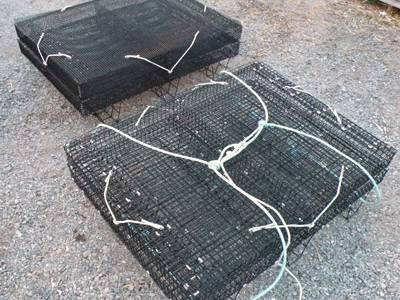
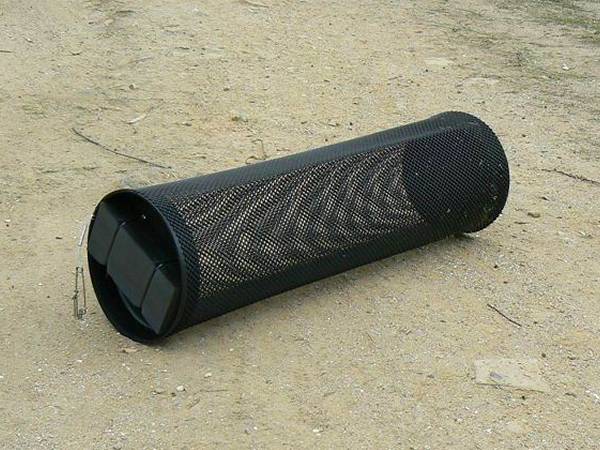
 # Anchovies process
- [Anchovies(江鱼仔) process](https://www.youtube.com/watch?v=rHYgoOvGNXg)
- [ikan Bilis (Teri) Malaysia](wwww.ikannbilis.com.my)
- Purse seine
# [Gyro stablizer](https://www.gineicomarine.com.au/how-does-a-gyro-stabiliser-work/)
[product stablizer list](https://www.zhoujiatech.com/product_list/1.html?gad_source=1&gad_campaignid=21732637351&gclid=EAIaIQobChMI6JDG79vZjQMV8qRmAh1fLhEvEAAYASAAEgIstfD_BwE)
## [tauri](https://tauri.app/start/prerequisites/#linux)
-[1](https://dioxuslabs.com/learn/0.6/guide/)
-[2](https://stackoverflow.com/questions/79425798/how-do-i-build-a-dioxus-bare-bones-project-in-nix)
-[dioxus lab](https://dioxuslabs.com/awesome/)
# [Fly-by-Wire (FBW)](https://www.aviation-accidents.net/fly-by-wire-airplanes/)
Fly-by-wire (FBW) cars utilize electronic systems instead of mechanical linkages to control driving functions.
This technology, similar to FBW in aviation, replaces traditional steering columns and pedals with electronic controls.
FBW allows for a more precise and potentially autonomous driving experience by eliminating the need for direct physical
connections between the driver's input and the vehicle's actions.
in a "fly-by-wire" (FBW) boat system, steering and throttle controls are not directly connected to the engine or
rudder mechanism with cables or rods. Instead, a computer receives inputs from the steering
wheel or joystick, processes them, and then sends electrical signals to actuators that control the boat's movement.
This technology replaces traditional mechanical linkages with electronic systems, offering advantages
like reduced weight, improved control, and potential for enhanced stability and automation
Fly-by-wire (FBW) is a flight control system that replaces the mechanical linkages between the pilot’s control inputs and the aircraft’s
control surfaces with electronic signals. In an FBW system, the pilot’s control inputs are detected by sensors and transmitted
to a computer system, which then calculates the appropriate response and sends signals to actuators that move the control surfaces.
[Fly-by-wire (FBW)](http://www2.coe.pku.edu.cn/tpic/20119195714364.pdf) is a system that replaces the
conventional manual flight controls of an aircraft with an electronic interface.
The movements of flight controls are converted to electronic signals transmitted by wires
(hence the fly-by-wire term), and flight control computers determine how to move the actuators
at each control surface to provide the ordered response.
The fly-by-wire system also allows automatic signals sent by the aircraft's computers to perform functions
without the pilot's input, as in systems that automatically help stabilize the aircraft.
# Low frequency vs High frequency Power Inverter
# PV to DC load
solar direct to DC without power inverters
52- 55 VDC 96 VDC or 110 VDC
```
menuentry "Kubuntu 24.04.2 Noble ISO" {
set isofile="/ISO/kubuntu-24.04.2-desktop-amd64.iso"
loopback loop (hd1,5)$isofile
linux (loop)/casper/vmlinuz boot=casper iso-scan/filename=$isofile toram noeject
initrd (loop)/casper/initrd
}
```
# Perlu kapal 40HP untuk perairan dengan laut lepas (tanjung pinang)
# [Marketing fish](https://indofishmart.id)
https://indofishmart.id/kerapu-cantang-hybrida-kerapu-yang-diminati-di-tiongkok-peluang-besar-untuk-ekspor-laut-indonesia/
- [Hatchery pemijahan](https://repository.ub.ac.id/id/eprint/135643/2/PKL.pdf)
- [Journal perikanan](https://journal.asrihindo.or.id/index.php/Manfish/index)
- [Journal kerapu cantang](https://journal.umg.ac.id/index.php/jpp/article/view/7239/4041)
- [benih kerapu cantang](https://www.sikumis.com/produk/benih-kerapu-hybrid-cantang-macan-x-kertang-8-cm)
Hibridisasi dilakukan dengan metode pembuahan buatan (artificial fertilization). **Kelamin kedua induk diurut agar telur
dan sperma keluar melalui saluran kelaminnya. Setelah itu, telur dan sperma dicampurkan secara merata di dalam wadah baskom.**
* Fertelization rate is 50%
* Hatching rate hibrida larger than 50%.
**Bagian penting dari hibridisasi ini adalah pengambilan sperma pada induk kerapu kertang jantan.**
Sperma yang diambil tidak boleh sampai tercampur dengan air laut ataupun kotoran dari induk,
pasalnya keduanya dapat menurunkan motilitas sperma sehingga tingkat pembuahan akan menurun.
Telur kerapu hibrida akan menetas setelah 20 jam pembuahan. Panjang larva kerapu hibrida sekitar 1,6–1,8 mm.
Pakan Larva kerapu
# udang rebon (Mesopodopsis sp.)
* Udang rebon adalah salah satu jenis udang air laut yang memiliki nilai ekonomi tinggi dan banyak dimanfaatkan
sebagai bahan baku pembuatan terasi, serta menjadi objek penelitian dalam bidang ilmu kelautan dan biologi
Chlorella sp.
Chlorella sp. diberikan saat hari ketiga penebaran telur. Pemberian Chlorella sp.
dengan cara dialirkan dari bak kultur Chlorella sp. ke bak pemeliharaan larva. Kultur
Chlorella sp. diawali dengan mengisi bak kultur dengan air laut hingga mencapai volume
50% dari volume total. Selanjutnya, diisi bibit Chlorella sp. sebanyak 30% dari volume
total bak. Pupuk urea 70 ppm, ZA 40 ppm dan TSP 38 ppm diberikan untuk menambah
nutrisi dan meningkatkan pertumbuhan Chlorella sp. yang dikultur. Setiap unsur hara
mempunyai fungsi khusus pada pertumbuhan dan kepadatan pakan alami. Dosis
pemupukan yang tepat dan cara yang baik adalah salah satu faktor penting dalam proses
kultur pakan alami. Chlorella sp. dapat dipanen setelah 5 hari kultur
Rotifera sp.
Rotifera sp. digunakan untuk larva berumur 3 hari (D3) sampai larva berumur 40 hari
(D40). Pemberian Rotifera sp. dilakukan dengan cara ditebar dengan perlahan pada bak
pemeliharaan larva. Pemberian Rotifera sp. sebanyak 3x, yaitu pukul 08.00, 09.00 dan
10.00 WIB. Pemberian Rotifera sp. diberikan dengan dosis 10 ind/ml. Letak bak
Chlorella sp. dan bak Rotifera sp. harus berjauhan. Hal ini bertujuan untuk mencegah
kontaminasi dan mencegah peralihan organisme pakan alami yang dikultur. Hal ini sesuai
dengan pendapat Rahmaningsih dan Ari (2013), bahwa penempatan lokasi bak kultur
Rotifera sp. harus dijauhkan dari bak kultur Chlorella sp., karena dapat mengakibatkan
habisnya Chlorella yang termakan oleh Rotifera. Cara mengkultur Rotifera yaitu dengan
cara menambhakan air laut sebanyak 5 ton, dan dicampurkan dengan 5 ton Chlorella, dan
3 ton bibit Rotifera. Setelah 2 hari Rotifera dapat dipanen.
Artemia sp.
Sebelum diberikan kepada larva, Artemia harus ditetaskan terlebih dahulu.
Cara penetasan yang dilakukan di CV. SBB 88 dibagi menjadi 2 tahapan, yaitu
dekapsulasi dan penetasan cyste artemia. Dekapsulasi dilakukan dengan cara
menyiapkan cyste artemia dan diletakkan dalam timba yang bervolume 12liter.
Setelah itu diberikan klorin sebanyak 500 ml dan diaduk menggunakan pipa
panjang serta didiamkan selama 1 jam. Selanjutnya, diaduk hingga berubah warna
dari yang awalnya coklat tua menjadi coklat muda. Setelah itu cyste artemia
disaring menggunakan seser dan dicuci menggunakan air tawar. Cyste artemia
disimpan di dalam kulkas sebelum ditetaskan. Penetasan artemia menggunakan
timba bervolume 50liter yang sudah diisi air laut dan aerasi. Cyste artemia yang
sudah didekapsulasi ditetaskan pada wadah tersebut sebanyak 50gram dan
diaerasi dengan kekuatan tinggi. Proses penetasan Artemia membutuhkan waktu
selama 10-12 jam. Pemberian artemia yang dilakukan di CV. SBB 88 adalah
setelah larva berumur 15 hari (D15) sampai larva berumur 40 hari (D40).
Pemberian pakan alami berupa Artemia dilakukan dalam 3 kali yakni pada jam
08.00, 10.00, dan 14.00 WIB. Setiap pemberian pakan berupa Artemia, dapat
dihitung kepadatannya mencapai 10 ind/ml.
Pemberian udang rebon
Pakan udang rebon diberikan pada saat larva berumur 26 hari (D26), dengan
dosis pemberian adlibitum. Dilakukan sebanyak dua kali sehari pukul 09.00 dan 11.00
WIB setelah pemberian Artemia.
# Anchovies process
- [Anchovies(江鱼仔) process](https://www.youtube.com/watch?v=rHYgoOvGNXg)
- [ikan Bilis (Teri) Malaysia](wwww.ikannbilis.com.my)
- Purse seine
# [Gyro stablizer](https://www.gineicomarine.com.au/how-does-a-gyro-stabiliser-work/)
[product stablizer list](https://www.zhoujiatech.com/product_list/1.html?gad_source=1&gad_campaignid=21732637351&gclid=EAIaIQobChMI6JDG79vZjQMV8qRmAh1fLhEvEAAYASAAEgIstfD_BwE)
## [tauri](https://tauri.app/start/prerequisites/#linux)
-[1](https://dioxuslabs.com/learn/0.6/guide/)
-[2](https://stackoverflow.com/questions/79425798/how-do-i-build-a-dioxus-bare-bones-project-in-nix)
-[dioxus lab](https://dioxuslabs.com/awesome/)
# [Fly-by-Wire (FBW)](https://www.aviation-accidents.net/fly-by-wire-airplanes/)
Fly-by-wire (FBW) cars utilize electronic systems instead of mechanical linkages to control driving functions.
This technology, similar to FBW in aviation, replaces traditional steering columns and pedals with electronic controls.
FBW allows for a more precise and potentially autonomous driving experience by eliminating the need for direct physical
connections between the driver's input and the vehicle's actions.
in a "fly-by-wire" (FBW) boat system, steering and throttle controls are not directly connected to the engine or
rudder mechanism with cables or rods. Instead, a computer receives inputs from the steering
wheel or joystick, processes them, and then sends electrical signals to actuators that control the boat's movement.
This technology replaces traditional mechanical linkages with electronic systems, offering advantages
like reduced weight, improved control, and potential for enhanced stability and automation
Fly-by-wire (FBW) is a flight control system that replaces the mechanical linkages between the pilot’s control inputs and the aircraft’s
control surfaces with electronic signals. In an FBW system, the pilot’s control inputs are detected by sensors and transmitted
to a computer system, which then calculates the appropriate response and sends signals to actuators that move the control surfaces.
[Fly-by-wire (FBW)](http://www2.coe.pku.edu.cn/tpic/20119195714364.pdf) is a system that replaces the
conventional manual flight controls of an aircraft with an electronic interface.
The movements of flight controls are converted to electronic signals transmitted by wires
(hence the fly-by-wire term), and flight control computers determine how to move the actuators
at each control surface to provide the ordered response.
The fly-by-wire system also allows automatic signals sent by the aircraft's computers to perform functions
without the pilot's input, as in systems that automatically help stabilize the aircraft.
# Low frequency vs High frequency Power Inverter
# PV to DC load
solar direct to DC without power inverters
52- 55 VDC 96 VDC or 110 VDC
```
menuentry "Kubuntu 24.04.2 Noble ISO" {
set isofile="/ISO/kubuntu-24.04.2-desktop-amd64.iso"
loopback loop (hd1,5)$isofile
linux (loop)/casper/vmlinuz boot=casper iso-scan/filename=$isofile toram noeject
initrd (loop)/casper/initrd
}
```
# Perlu kapal 40HP untuk perairan dengan laut lepas (tanjung pinang)
# [Marketing fish](https://indofishmart.id)
https://indofishmart.id/kerapu-cantang-hybrida-kerapu-yang-diminati-di-tiongkok-peluang-besar-untuk-ekspor-laut-indonesia/
- [Hatchery pemijahan](https://repository.ub.ac.id/id/eprint/135643/2/PKL.pdf)
- [Journal perikanan](https://journal.asrihindo.or.id/index.php/Manfish/index)
- [Journal kerapu cantang](https://journal.umg.ac.id/index.php/jpp/article/view/7239/4041)
- [benih kerapu cantang](https://www.sikumis.com/produk/benih-kerapu-hybrid-cantang-macan-x-kertang-8-cm)
Hibridisasi dilakukan dengan metode pembuahan buatan (artificial fertilization). **Kelamin kedua induk diurut agar telur
dan sperma keluar melalui saluran kelaminnya. Setelah itu, telur dan sperma dicampurkan secara merata di dalam wadah baskom.**
* Fertelization rate is 50%
* Hatching rate hibrida larger than 50%.
**Bagian penting dari hibridisasi ini adalah pengambilan sperma pada induk kerapu kertang jantan.**
Sperma yang diambil tidak boleh sampai tercampur dengan air laut ataupun kotoran dari induk,
pasalnya keduanya dapat menurunkan motilitas sperma sehingga tingkat pembuahan akan menurun.
Telur kerapu hibrida akan menetas setelah 20 jam pembuahan. Panjang larva kerapu hibrida sekitar 1,6–1,8 mm.
Pakan Larva kerapu
# udang rebon (Mesopodopsis sp.)
* Udang rebon adalah salah satu jenis udang air laut yang memiliki nilai ekonomi tinggi dan banyak dimanfaatkan
sebagai bahan baku pembuatan terasi, serta menjadi objek penelitian dalam bidang ilmu kelautan dan biologi
Chlorella sp.
Chlorella sp. diberikan saat hari ketiga penebaran telur. Pemberian Chlorella sp.
dengan cara dialirkan dari bak kultur Chlorella sp. ke bak pemeliharaan larva. Kultur
Chlorella sp. diawali dengan mengisi bak kultur dengan air laut hingga mencapai volume
50% dari volume total. Selanjutnya, diisi bibit Chlorella sp. sebanyak 30% dari volume
total bak. Pupuk urea 70 ppm, ZA 40 ppm dan TSP 38 ppm diberikan untuk menambah
nutrisi dan meningkatkan pertumbuhan Chlorella sp. yang dikultur. Setiap unsur hara
mempunyai fungsi khusus pada pertumbuhan dan kepadatan pakan alami. Dosis
pemupukan yang tepat dan cara yang baik adalah salah satu faktor penting dalam proses
kultur pakan alami. Chlorella sp. dapat dipanen setelah 5 hari kultur
Rotifera sp.
Rotifera sp. digunakan untuk larva berumur 3 hari (D3) sampai larva berumur 40 hari
(D40). Pemberian Rotifera sp. dilakukan dengan cara ditebar dengan perlahan pada bak
pemeliharaan larva. Pemberian Rotifera sp. sebanyak 3x, yaitu pukul 08.00, 09.00 dan
10.00 WIB. Pemberian Rotifera sp. diberikan dengan dosis 10 ind/ml. Letak bak
Chlorella sp. dan bak Rotifera sp. harus berjauhan. Hal ini bertujuan untuk mencegah
kontaminasi dan mencegah peralihan organisme pakan alami yang dikultur. Hal ini sesuai
dengan pendapat Rahmaningsih dan Ari (2013), bahwa penempatan lokasi bak kultur
Rotifera sp. harus dijauhkan dari bak kultur Chlorella sp., karena dapat mengakibatkan
habisnya Chlorella yang termakan oleh Rotifera. Cara mengkultur Rotifera yaitu dengan
cara menambhakan air laut sebanyak 5 ton, dan dicampurkan dengan 5 ton Chlorella, dan
3 ton bibit Rotifera. Setelah 2 hari Rotifera dapat dipanen.
Artemia sp.
Sebelum diberikan kepada larva, Artemia harus ditetaskan terlebih dahulu.
Cara penetasan yang dilakukan di CV. SBB 88 dibagi menjadi 2 tahapan, yaitu
dekapsulasi dan penetasan cyste artemia. Dekapsulasi dilakukan dengan cara
menyiapkan cyste artemia dan diletakkan dalam timba yang bervolume 12liter.
Setelah itu diberikan klorin sebanyak 500 ml dan diaduk menggunakan pipa
panjang serta didiamkan selama 1 jam. Selanjutnya, diaduk hingga berubah warna
dari yang awalnya coklat tua menjadi coklat muda. Setelah itu cyste artemia
disaring menggunakan seser dan dicuci menggunakan air tawar. Cyste artemia
disimpan di dalam kulkas sebelum ditetaskan. Penetasan artemia menggunakan
timba bervolume 50liter yang sudah diisi air laut dan aerasi. Cyste artemia yang
sudah didekapsulasi ditetaskan pada wadah tersebut sebanyak 50gram dan
diaerasi dengan kekuatan tinggi. Proses penetasan Artemia membutuhkan waktu
selama 10-12 jam. Pemberian artemia yang dilakukan di CV. SBB 88 adalah
setelah larva berumur 15 hari (D15) sampai larva berumur 40 hari (D40).
Pemberian pakan alami berupa Artemia dilakukan dalam 3 kali yakni pada jam
08.00, 10.00, dan 14.00 WIB. Setiap pemberian pakan berupa Artemia, dapat
dihitung kepadatannya mencapai 10 ind/ml.
Pemberian udang rebon
Pakan udang rebon diberikan pada saat larva berumur 26 hari (D26), dengan
dosis pemberian adlibitum. Dilakukan sebanyak dua kali sehari pukul 09.00 dan 11.00
WIB setelah pemberian Artemia.
 The conversion factor between these units is approximately:1 °dH (dGH) = 17.9 mg/L (ppm) as CaCO₃
Given a GH of 300 mg/L (which is also 300 ppm), the conversion is as follows: GH in mg/L (as CaCO₃):300 mg/L (or 300 ppm)
GH in degrees German Hardness (°dH or dGH):\(300\,\text{mg/L}\div 17.9\,(\text{mg/L\ per\ dGH})\approx \mathbf{16.8}\,
\mathbf{dGH}\)
The General Hardness (GH) of natural seawater is typically much higher than 300 ppm, generally around
6,570 ppm (parts per million). Therefore, your reading of GH 300 ppm in seawater suggests the water may be diluted or formulated incorrectly, which could be problematic for sea cucumbers.
Seawater GH and Sea Cucumbers
Natural Seawater Hardness: Seawater is inherently "very hard" due to high concentrations of dissolved minerals, primarily calcium and magnesium ions. A typical GH value is about 6,570 ppm.
300 ppm GH in Seawater: This level of GH is characteristic of hard freshwater (approximately 16.7 dGH) or brackish water, not full-strength seawater.
Sea Cucumber Tolerance: Sea cucumbers (echinoderms) have limited adaptability to significant salinity changes and require stable water parameters. Their optimal environment is full-strength seawater, typically with a salinity range of 30-34 parts per thousand (ppt), which corresponds to a much higher GH.
Potential Issues: The 300 ppm GH level indicates a low mineral concentration (and likely low salinity). This suboptimal condition can cause osmotic stress, weaken the sea cucumber's immune system, and negatively affect growth and survival.
Recommended Action
You should focus on maintaining proper salinity as the primary water parameter for sea cucumbers, as GH measurements for marine systems are not standard or practical due to the high mineral content.
Measure Salinity: Use a refractometer or hydrometer to measure the salinity (or specific gravity) of the water.
Target Range: Aim for a salinity of 30 to 34 ppt (parts per thousand) for optimal health and survival.
Adjust Water: If your salinity is low, gradually increase it using a quality marine salt mix.
Monitor other parameters: Ensure other critical water parameters like temperature, pH (7.6-8.4), and dissolved oxygen are within acceptable ranges for sea cucumbers
# Purse Saine
The conversion factor between these units is approximately:1 °dH (dGH) = 17.9 mg/L (ppm) as CaCO₃
Given a GH of 300 mg/L (which is also 300 ppm), the conversion is as follows: GH in mg/L (as CaCO₃):300 mg/L (or 300 ppm)
GH in degrees German Hardness (°dH or dGH):\(300\,\text{mg/L}\div 17.9\,(\text{mg/L\ per\ dGH})\approx \mathbf{16.8}\,
\mathbf{dGH}\)
The General Hardness (GH) of natural seawater is typically much higher than 300 ppm, generally around
6,570 ppm (parts per million). Therefore, your reading of GH 300 ppm in seawater suggests the water may be diluted or formulated incorrectly, which could be problematic for sea cucumbers.
Seawater GH and Sea Cucumbers
Natural Seawater Hardness: Seawater is inherently "very hard" due to high concentrations of dissolved minerals, primarily calcium and magnesium ions. A typical GH value is about 6,570 ppm.
300 ppm GH in Seawater: This level of GH is characteristic of hard freshwater (approximately 16.7 dGH) or brackish water, not full-strength seawater.
Sea Cucumber Tolerance: Sea cucumbers (echinoderms) have limited adaptability to significant salinity changes and require stable water parameters. Their optimal environment is full-strength seawater, typically with a salinity range of 30-34 parts per thousand (ppt), which corresponds to a much higher GH.
Potential Issues: The 300 ppm GH level indicates a low mineral concentration (and likely low salinity). This suboptimal condition can cause osmotic stress, weaken the sea cucumber's immune system, and negatively affect growth and survival.
Recommended Action
You should focus on maintaining proper salinity as the primary water parameter for sea cucumbers, as GH measurements for marine systems are not standard or practical due to the high mineral content.
Measure Salinity: Use a refractometer or hydrometer to measure the salinity (or specific gravity) of the water.
Target Range: Aim for a salinity of 30 to 34 ppt (parts per thousand) for optimal health and survival.
Adjust Water: If your salinity is low, gradually increase it using a quality marine salt mix.
Monitor other parameters: Ensure other critical water parameters like temperature, pH (7.6-8.4), and dissolved oxygen are within acceptable ranges for sea cucumbers
# Purse Saine


graph LR
%% This is a comment!!!
%% Apple Cedar Vinegar
ACV["Apple cider Vinegar"] --->UF["Unfilter vinegar"]
ACV --->F["Filter Vinegar"]
graph LR
%% This is a comment!!!
%% Coffee process
Coffee["Red Cheery ripe handpick"] ---> P1["sorted size
and sun dry"] ---> P2["storage or
need to remove the skin"] P2 ---> P3["greem bean
still have membrance coffee"] ----> R1["Light roasting
remove membrance"] R1 ---R2["Roasting for demand"]
and sun dry"] ---> P2["storage or
need to remove the skin"] P2 ---> P3["greem bean
still have membrance coffee"] ----> R1["Light roasting
remove membrance"] R1 ---R2["Roasting for demand"]
graph LR
%% This is a comment!!!
%% Pelabuhan di Batam
A[fas:fa-ship Tajuh Biru Mon & Thu
Lingga] --> B0[fas:fa-ship 🦞🐟frozen/live
Belakang Padang
Batam] -- Singapore GST 9.00%--> S0[/"Singapore GST 9.00+ import tax?
Jurong fish port(30% import)
Singapore"/] --logistic cost + 2.00SGD -->S1[/Closed March 2024
Senoko Fishery Port
Singapore/] B1[fas:fa-ship 🦞🐟 frozen/live
Sagulung daily
Batam] --freight charge 18SGD 100cm x 50cm x 50cm \( 50~90 kg\) -->S0 J1["fas:fa-ship Pelabuhan Hasim
Balerang, Batam"] <---->|Private Boat 00:45, 16.00km?| P["Ke Pulauan Petong 🥽"] J7["fas:fa-ship Pel. Pari Jembatan 6
Batam"] <---->|Private Boat 00:45, 16.00km?| PB["Pulan Benan 🥽"] J7 <-->A TPunggur["fas:fa-ship Pelabuhan Telaga Punggur
Batam"] <---->|01:45?| PB <---> |00:45 | A J6["fas:fa-ship Pel. Kepri Coral
Batam"]<-->P TP["fas:fa-ship Tanjung Pinang"] <-- Public --> A style S1 fill:red click A "https://docs.google.com/forms/d/e/1FAIpQLSfVlANgYbnoqzFn5tKd4520MAiF10Sgqg343FKI2oTYmhcP8Q/viewform?usp=sharing" "budiday lobster" click P "https://batamnewsasia.com/2024/11/11/explore-pulau-petong-batams-underwater-paradise-for-tourists/" "Pulau Petong" click B1 "https://www.google.com/maps/d/edit?mid=1k7qpHqVpCqY_taRwkaVSyDc8yo8jmFo&usp=sharing" "Pel Sagulung bpk Hamzah" click TPunggur "https://www.tiketkapal.com/" "Ferry ke pulau"
Lingga] --> B0[fas:fa-ship 🦞🐟frozen/live
Belakang Padang
Batam] -- Singapore GST 9.00%--> S0[/"Singapore GST 9.00+ import tax?
Jurong fish port(30% import)
Singapore"/] --logistic cost + 2.00SGD -->S1[/Closed March 2024
Senoko Fishery Port
Singapore/] B1[fas:fa-ship 🦞🐟 frozen/live
Sagulung daily
Batam] --freight charge 18SGD 100cm x 50cm x 50cm \( 50~90 kg\) -->S0 J1["fas:fa-ship Pelabuhan Hasim
Balerang, Batam"] <---->|Private Boat 00:45, 16.00km?| P["Ke Pulauan Petong 🥽"] J7["fas:fa-ship Pel. Pari Jembatan 6
Batam"] <---->|Private Boat 00:45, 16.00km?| PB["Pulan Benan 🥽"] J7 <-->A TPunggur["fas:fa-ship Pelabuhan Telaga Punggur
Batam"] <---->|01:45?| PB <---> |00:45 | A J6["fas:fa-ship Pel. Kepri Coral
Batam"]<-->P TP["fas:fa-ship Tanjung Pinang"] <-- Public --> A style S1 fill:red click A "https://docs.google.com/forms/d/e/1FAIpQLSfVlANgYbnoqzFn5tKd4520MAiF10Sgqg343FKI2oTYmhcP8Q/viewform?usp=sharing" "budiday lobster" click P "https://batamnewsasia.com/2024/11/11/explore-pulau-petong-batams-underwater-paradise-for-tourists/" "Pulau Petong" click B1 "https://www.google.com/maps/d/edit?mid=1k7qpHqVpCqY_taRwkaVSyDc8yo8jmFo&usp=sharing" "Pel Sagulung bpk Hamzah" click TPunggur "https://www.tiketkapal.com/" "Ferry ke pulau"
flowchart TB
subgraph OCEAN9 ["fas:fa-ship OCEAN 9 "]
direction LR
TP([Telaga Punggur])-->|ferry 11:00 web kapaltiket.com| A([BENAN]) --> |"00:45"| B([Tajuh Biru]) --> C(["Sei Tenam"]) --> D(["Senayang"]) <--->|"from 07:15 Pancur"| E(["Pancur"])
end
subgraph DRAGON5 ["fas:fa-ship DRAGON 5"]
direction LR
TP1(["Telaga punggur"]) --> CC(["Sei Tenam"])-->JG(["Jagoh"])
end
subgraph Anambas ["fas:fa-ship Anambas"]
direction LR
TP2(["Telaga Punggur"]) --"Rp. 494k"--> Letung --"Rp 495k"--> Terempa(["Terempa"])
end
subgraph Bintan["Pulau Bintan/Tanjung Pinang"]
direction LR
BTP(["Tanjung Pinang"])
end
subgraph Sungaibuluh["Sungai Buluh- Posik"]
direction LR
JG --> |"pompong atau ojek"| SGBuluh(["Sungai Buluh"])-->|ferry ke| posek{"Posek"}
end
TP <--.--> TP1 <--.--> TP2
style A fill: black, color: white
style B fill:grey, color:#fff
style TP fill:blue, color: whit
style TP1 fill:blue, color: white
style TP2 fill:blue, color: white
click BTP "https://www.welcometobintan.com/images/map.jpg" "Tanjung Pinang"
%%{init: {"pie": {"textPosition": 0.5}, "themeVariables": {"pieOuterStrokeWidth": "5px"}} }%%
pie title International Reserves Of Central Banks Worldwide
"US" :58.4
"Euro" : 20.50
"Chinese RMB" : 2.7
"Japanese Yen": 5.5
"Pound Sterling": 4.9
"Australian Dollars": 2.0
"Canadian Dollar": 2.4
"Other Currencies": 3.5
pie title Investment weighting factor
"Money" :60
"Labour" : 35
"Technology-Consultant" : 5
timeline
%% https://ikanbilis.com.my/
title Panen anchovies di Lingga
Jan
: Weather/wet/highwave
Feb
: Weather/wet/highwave
Mar
: Weather/wet/highwave
Apr
: Squid/Anchovies
May
: Squid/Anchovies
Jun
: Squid/Anchovies
Jul
: Squid/Anchovies
Aug
: Squid/Anchovies
Sep
: Squid/Anchovies
Oct
: Squid/Anchovies
Nov
: Squid/Anchovies
Dec
: weather/wet/highwave
: Lobster/udang kara/banana shrimp
withdraw: next years with draw get 1 dollars
up to 6 years before can get as according to percentage
profit allocate 20% profit forfuture reinvestment
money(60%) | labor (40%-->
Manager(60%) + worker(40%)| Calculation
Propotion| |-------|-------------|------|-------------| | A | 100K x 0.6 | 0 | 100K/200K*0.6=0.3 | | B | 100K x 0.6 | 0.4 x 0.6=0.24|30% +24%=54%| | C | 0 | 0.4 x 0.4=0.16 | 16% | Kerapu Cantang Hitam vs. Kerapu Cantang Kuning Kerapu Cantang adalah hasil hibridisasi (persilangan buatan) antara Kerapu Macan (Epinephelus fuscoguttatus) betina dan Kerapu Kertang (Epinephelus lanceolatus) jantan. Namun, terdapat variasi warna pada kerapu cantang, seperti hitam dan kuning, yang dipengaruhi oleh faktor genetik dan lingkungan. Perbedaan Kerapu Cantang Hitam vs. Kuning Kriteria Kerapu Cantang Hitam Kerapu Cantang Kuning Warna Tubuh Dominan hitam atau abu-abu gelap dengan bercak hitam Dominan kuning keemasan dengan bercak cokelat atau hitam Pertumbuhan Cenderung lebih cepat Sedikit lebih lambat dibanding hitam Harga Pasar Biasanya lebih tinggi karena permintaan lebih besar Sedikit lebih murah Kandungan Gizi Sama (tinggi protein, rendah lemak) Sama (tinggi protein, rendah lemak) Rasa & Tekstur Daging lebih padat, cocok untuk bakar & kukus Daging lembut, cocok untuk sup & tumis Ketahanan Penyakit Lebih tahan terhadap stres lingkungan Sedikit lebih rentan terhadap perubahan kualitas air Faktor yang Mempengaruhi Warna Genetik – Variasi gen dari indukan memengaruhi pigmentasi. Pakan – Kandungan astaxanthin (pigmen karotenoid) dalam pakan dapat memperkuat warna kuning. Lingkungan – Kualitas air, intensitas cahaya, dan substrat tambak memengaruhi warna. Kesimpulan Kerapu Cantang Hitam lebih populer di pasar karena pertumbuhannya cepat dan warna yang menarik. Kerapu Cantang Kuning memiliki keunikan warna yang cocok untuk hidangan tertentu. Keduanya sama-sama bernilai ekonomis tinggi dan banyak dibudidayakan di Indonesia. Jika Anda ingin membudidayakan atau membelinya, pilih sesuai preferensi pasar atau kebutuhan kuliner. 🐟🔥 # Endoscope 1. Diameter (8.0mm vs. 7.00mm)- one lense and 2 lenses Feature 8.0mm Endoscope 7.00mm Endoscope Size Slightly thicker More slender Flexibility Less flexible More flexible Applications Better for larger gaps (e.g., pipes, automotive) Better for tight spaces (e.g., electronics, narrow pipes) Key Takeaway: 7.00mm is better for confined spaces (e.g., engine crevices, plumbing). 8.0mm may offer better durability due to thicker construction. # Azolla as chicken and duck feed - layer feed - take nitrogen from air - cyno baceria: double every 2 -3 days - ash water for drinking water to lower pH - lime or calcium